
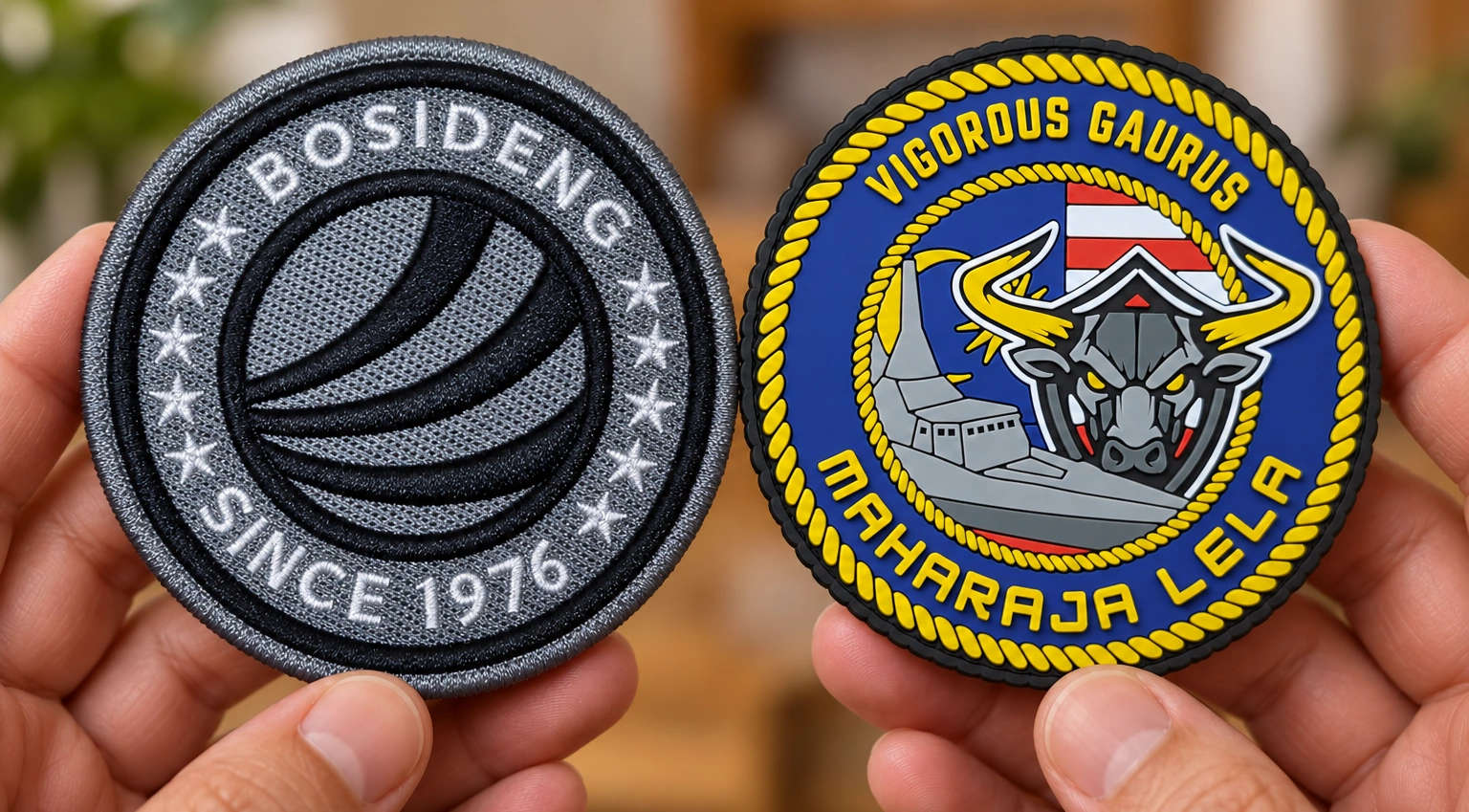
Start with where the patch will live. Gear that gets wet, muddy or oily points toward PVC, because its molded face sheds water and wipes clean. A patch on a uniform, a soft shirt or a cap that should look stitched points toward embroidery. It is thinner, follows the fabric, and needs no tooling for each design.
Then look at the artwork and the budget. PVC turns a logo into a few solid, molded colors, with relief planned in a mold, and that mold makes a first order of PVC cost more than the same patch embroidered. Most other differences between embroidered vs PVC patches follow from those two points.
Embroidered vs PVC patches at a glance
| Difference | Embroidered | PVC |
|---|---|---|
| 1. How it is formed | Thread stitched over a paper or iron-on film backing; a fabric base such as twill is optional | Liquid PVC filled color by color into a metal mold and cured with heat |
| 2. Surface and relief | Raised stitch texture with a textile feel; satin areas show a sheen | Smooth molded surface; flat-topped steps (2D) or rounded, sculpted relief (3D) |
| 3. Color and artwork | Closest match from a thread color range; stitch techniques can blend thread colors into a gradient | Each color is a separate solid area; 2–4 colors is the easiest range to keep clear and economical |
| 4. Small detail | Detail below about 3 mm stops holding its shape | 2D holds simple text from 3 mm and lines from 0.6 mm; domed 3D details need 0.8–1 mm |
| 5. Thickness and feel | Thinner and softer; follows the fabric | Typically about 2.5–5 mm; bendable but firmer than embroidery |
| 6. Water and dirt | Thread and base fabric absorb water and can hold dirt | The face does not absorb water and wipes clean |
| 7. Cost structure | No mold; cost follows stitch count, coverage, size and thread colors | First order needs a mold; 3D molds cost more; we keep molds for two years for reorders |
How each patch is made — and why it matters
An embroidered patch takes its form from thread. Paper or an iron-on film sits under the stitching to hold it steady, with twill or felt added only when the design needs a fabric base, and the machine stitches the design: running stitches for outlines, satin columns for lettering and borders, fill stitches for larger areas. Its texture, its slight relief and its limit on fine detail all come from the thread. Our default is polyester embroidery thread, and other thread types can be specified for a project.
A PVC patch starts with a metal mold engraved with the design. Liquid PVC — a plastisol, PVC resin dispersed in a liquid plasticizer — is filled into the mold one color at a time, and heat turns each fill into a flexible solid. ChemCeed’s plastisol overview describes the change as gelation and fusion and notes that the amount of plasticizer sets how soft or hard the result is. The layers are cured in turn, then the backing goes on.
The mold is tied to one design at one size and one relief structure. Change the outline, the size or the relief and you need a new one; an embroidery file can simply be edited and stitched again. Relief and feel are hard to judge on screen for either construction, which is why every PatchCraftPro order goes through a pre-production sample before bulk production.
Surface, relief and color: what your artwork turns into
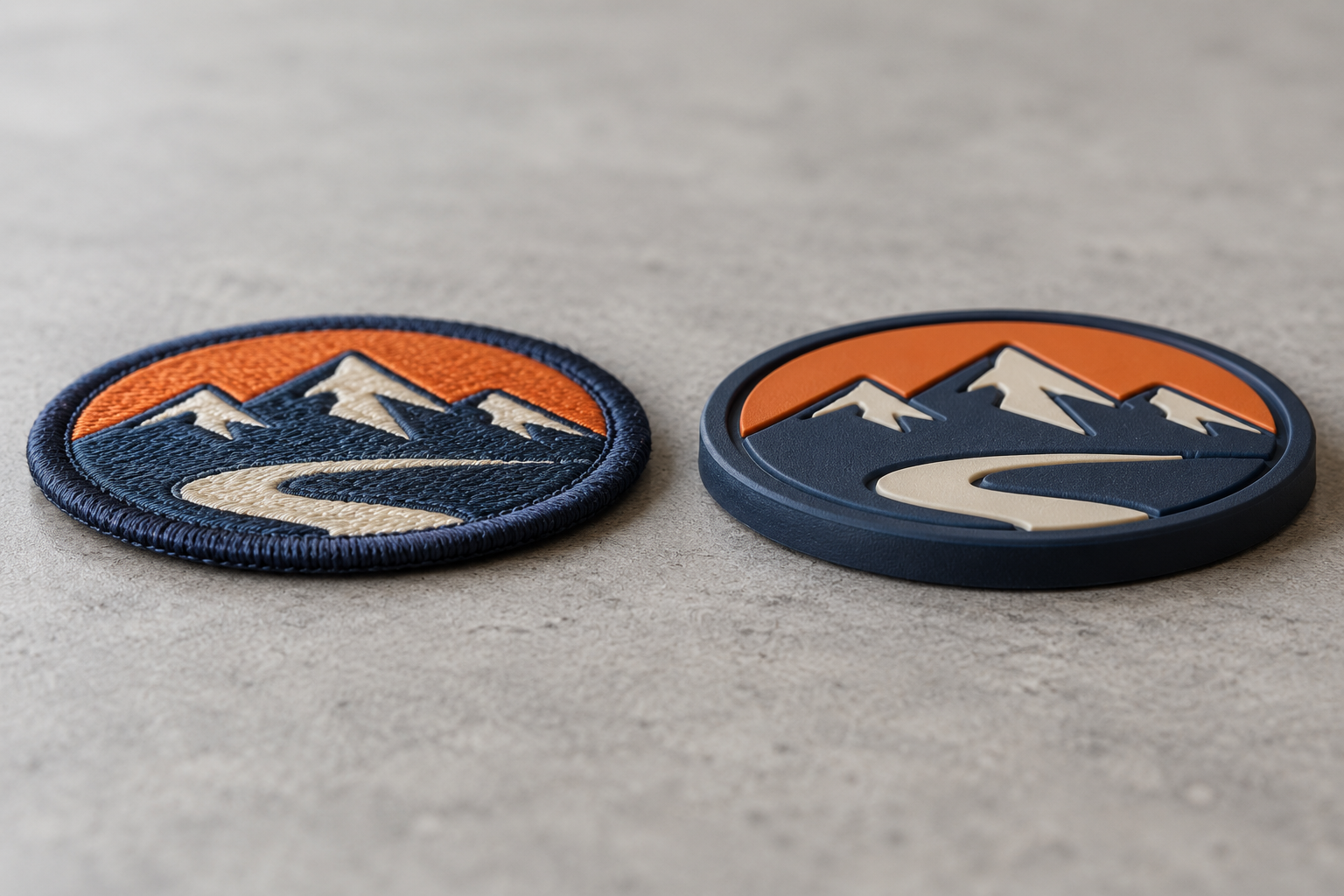
Embroidery reads as textile. Satin borders and fill areas catch the light along the stitch direction, and shape edges stay slightly soft. That look is often the point: club crests, workwear emblems and heritage branding are meant to look stitched.
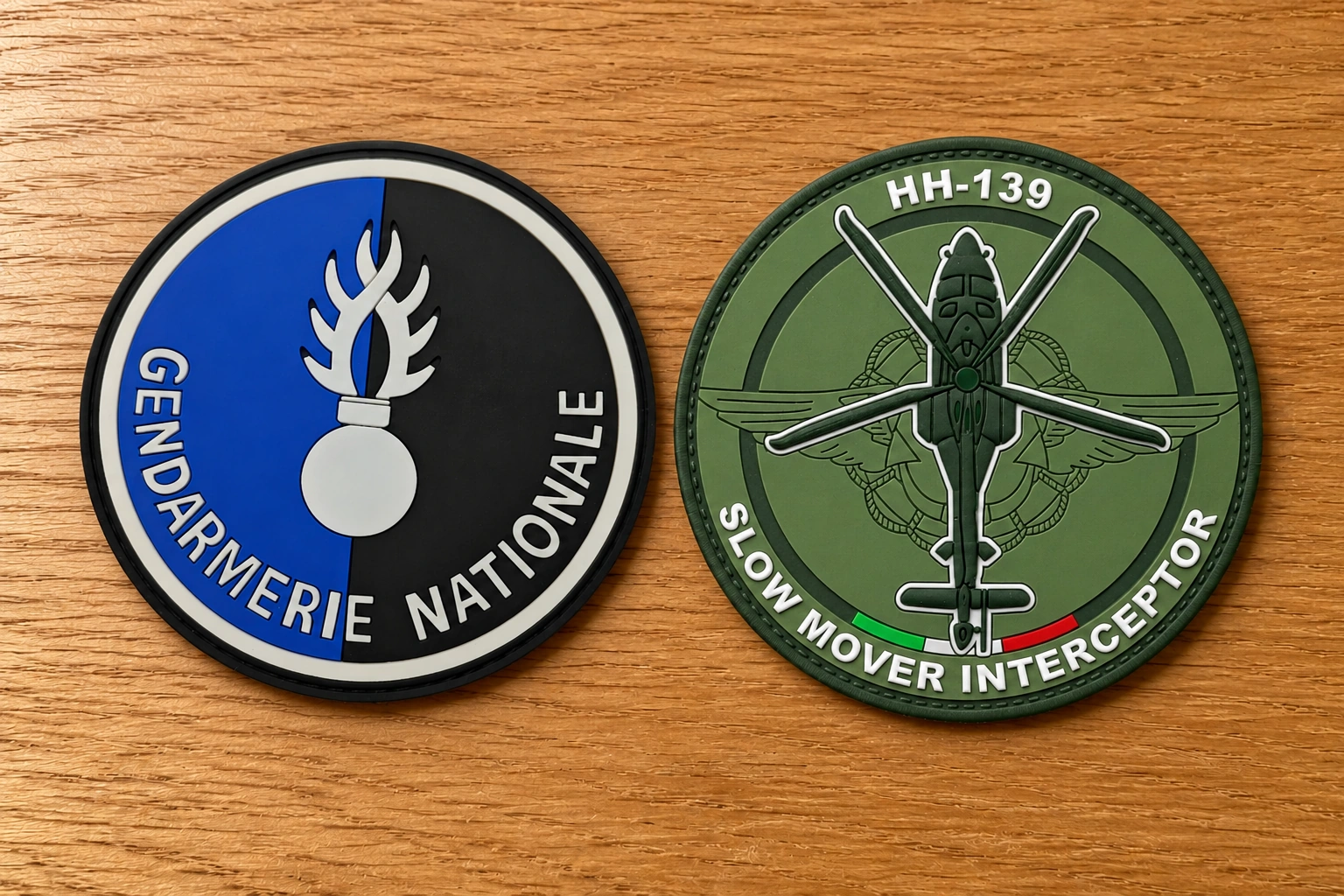
PVC reads as molded. 2D PVC is built as flat-topped steps, one level per color, which suits wordmarks, line art and text-heavy logos. 3D PVC is domed and sculpted, with rounded surfaces and more visible height, which suits animals, mascots, shields and overlapping elements. The difference is the shape of the surface, not just its thickness. The 2D and 3D options are on our custom PVC patches page.
Every PVC color fills its own cell in the mold, and the background counts as one of them. For a typical design we suggest 2–4 solid colors. That is a starting point, not a limit; more colors can be evaluated. More colors can cost more, depending on whether they go beyond the number included in the quote and whether they make the patch harder to produce. Our quote states how many colors are included and how additional ones are charged.
Molded color is solid color. Photographs, gradients and soft shadows do not translate into fills; for that artwork, compare printed patches, or a PVC patch with a printed area for the shaded part.
Small text and fine lines: closer than most comparisons suggest
Many PVC vs embroidered patches comparisons claim PVC wins on detail across the board. It depends on 2D or 3D. For 2D PVC we recommend text at least 3 mm tall and lines at least 0.6 mm wide on the finished patch; that applies to simple English letters and numbers. Chinese characters and complex typefaces get their own artwork review. Domed 3D lines need more width, at least 0.8–1 mm. Small text on a 3D patch is best kept as flat 2D lettering; if the lettering has to be domed too, the minimum height depends on the typeface and is confirmed on the artwork.
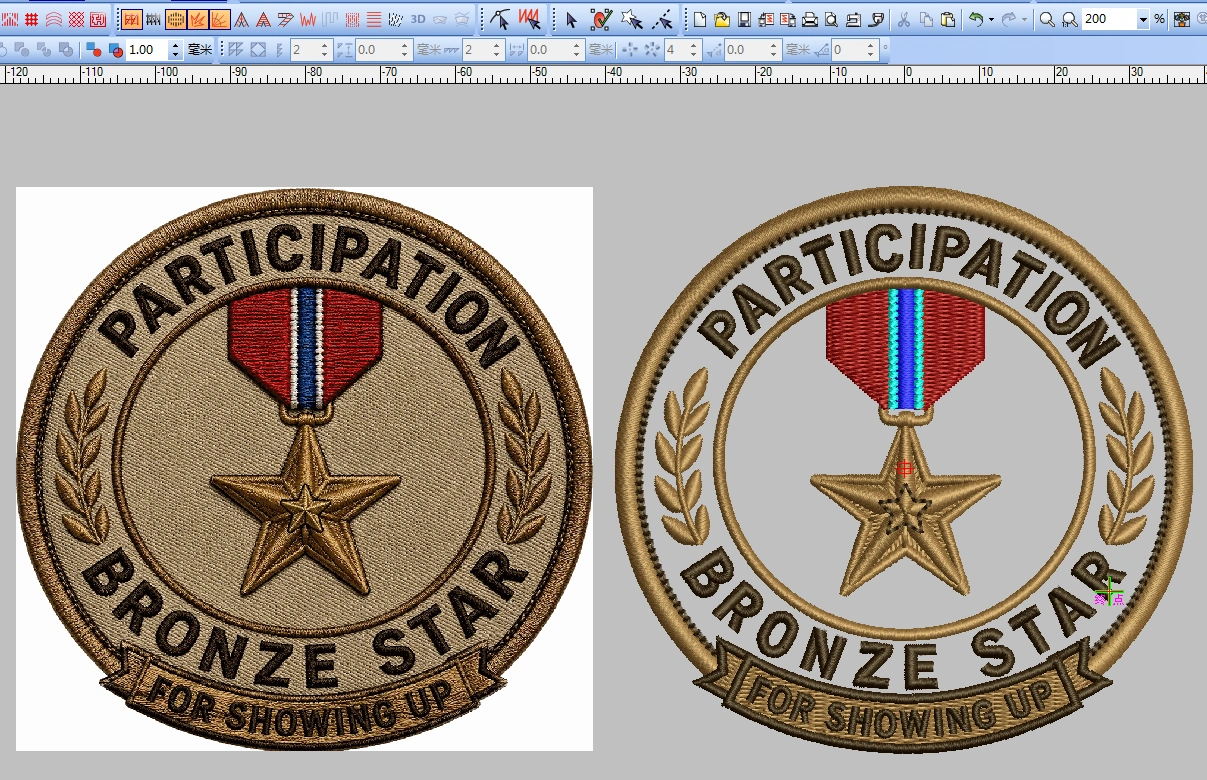
Embroidery’s floor is set by thread. Thread maker Madeira’s guidance on 60-weight thread puts clear block lettering at about 6–7 mm with standard 40-weight thread and about 3 mm with finer thread. We check every design at its finished size in embroidery software; detail that would have to be stitched below about 3 mm does not hold its shape, and small text above that line is stitched with a finer 75D thread.
So on simple text the two are close, while thin lines favor 2D PVC. If you want the traditional stitched, fabric look, choose embroidery. If the design depends on photos, gradients, shadows or dense small text, choose printing. Text that is too small for PVC is not automatically solved by switching to embroidery; woven patches or PVC with a printed area are often the better fix.
Thickness, flexibility and where each patch sits best
An embroidered patch bends with the garment and sits close to it. Soft PVC patches typically run about 2.5–5 mm thick: roughly 2.9–3.7 mm for flat, layered 2D designs and 4.4–4.7 mm for domed 3D designs. The exact figure for a given patch depends on its design and is confirmed on the sample. Both 2D and 3D feel like soft rubber and bend; 3D has more pronounced relief. How soft the finished patch is also depends on the PVC formulation, the thickness and the backing.
That body keeps a PVC patch flat on a bag, a plate carrier or a hook-and-loop panel. On a thin knit, a soft shirt or a sleeve that bends with the arm, the same patch can stand away from the fabric and feel stiff against the body.
Cold affects PVC more than thread. Its flexibility comes from the plasticizer, and plasticizer maker Eastman points out that the plasticizer choice determines low-temperature flexibility in PVC plastisols. For winter gear, judge the actual sample, not the word “PVC.”
On caps, a structured front panel carries either type. Soft crowns, beanies and curved side areas are better served by a thinner embroidered patch.
Water, dirt, sun and washing: what “weatherproof” really covers
PVC’s face does not absorb water, so mud, oil and rain wipe off. Thread and fabric soak up moisture, dry slowly and can hold dirt or odor when gear stays wet. For packs, tactical equipment, coolers and work gear, that is the strongest practical reason to choose PVC.
It covers the face only. A PVC patch does not make a jacket waterproof, and a waterproof face says nothing about whether its adhesive survives washing. Water still reaches the sewing line, the adhesive and the fabric behind a hook-and-loop panel.
Fading is often listed as an embroidery weakness. It depends mostly on the thread fiber: Madeira’s polyester thread guide describes polyester as fade- and bleach-resistant and suited to commercial laundering and outdoor use, unlike rayon — and polyester is the thread we use by default. PVC color stability depends on its pigments and stabilizers. We found no published, comparable test ranking the lifespan of the two, so treat “years outdoors” claims with caution.
Backing: which attachments suit each construction
Embroidered patches commonly take any of the four backings we offer: sew-on, iron-on, hook-and-loop and adhesive. Our iron-on and hook-and-loop backings use industrial-grade materials rather than standard grades.
For PVC, we choose the backing by use. Each option comes with conditions:
- Sew-on: the patch needs either a flat sewing margin or a recessed sewing channel around the edge. Both are built into the mold, so decide before the mold is made.
- Hook-and-loop: hook side, loop side, or both. A hook-backed patch on an item without a loop panel has nothing to grip.
- Adhesive: pressure-sensitive or a specified adhesive type. Don’t assume it will survive frequent washing.
- Iron-on: a dedicated hot-melt adhesive bonds the patch to the fabric using either a heat press or a household iron. Use the application settings specified for the patch and fabric.
- Magnetic: a magnet backing works on surfaces a magnet sticks to. Holding a patch through clothing needs a separately designed magnetic clasp.
What drives the cost of each construction
At the same size and 200 pieces, PVC usually costs more than standard embroidery, and 3D PVC usually more again. Color count is not the main reason. A first PVC order also carries the cost of the mold.
The mold is priced from the size, the complexity of the design and the relief structure. It may be charged separately or included in the order total. A 3D mold usually costs more than a 2D one; as a public reference, one supplier lists $60 for a 3-inch 2D mold and $100 for 3D, which is not our fixed price. Beyond the mold, detail, relief, thickness, backing and color count move the PVC price, while embroidery follows stitch count, set mainly by size and coverage.
Reorders change the math. If the design, size and structure stay the same and the mold has been kept in usable condition, it can usually be reused. A color change alone often needs no new mold; a new size, outline or relief usually does. We keep PVC molds for two years, and indefinitely for customers in a long-term partnership with us. With the mold reused, the gap between PVC and embroidery can narrow. That is why published embroidered patches vs PVC patches comparisons disagree so often on which is cheaper.
For a fair comparison, compare the total order price for both on the same artwork, size and backing. The minimum order is 200 pieces. Free design support includes a free digital proof for spelling, layout and color placement; relief, thickness and flexibility are checked on the pre-production sample.
Material compliance questions PVC raises
PVC contains plasticizers, and some buyers have to document which ones. In the EU, REACH restricts four phthalates — DEHP, DBP, BBP and DIBP — to below 0.1% by weight, combined, in the plasticized material of articles in general; TÜV Rheinland’s summary of the restriction notes the broadened scope applies from July 2020. In the US, the CPSC phthalate rule limits eight phthalates to 0.1% in children’s toys and child care articles.
If the patch will be sold in the EU, attached to a children’s product, or bought under a brand’s restricted-substance policy, tell us at the quote stage. We can provide a test report for the PVC so you can check it against the requirement that applies before approving the sample. Some brands avoid PVC altogether for sustainability reasons, and that settles the choice before the artwork does.
Embroidered vs PVC patches: choosing by use
| If your patch is for… | Start with | Why |
|---|---|---|
| Uniforms, workwear, club or heritage crests | Embroidered | Textile look, follows the garment, launders with it |
| Packs, tactical gear, plate carriers, coolers | PVC | Face sheds water and dirt; firm on hook-and-loop panels |
| Morale or swappable patches | PVC or embroidered on hook-and-loop | Removability comes from the backing, not the material |
| Soft shirts, knits, beanies, curved placements | Embroidered | Thinner and more flexible |
| A logo of 2–4 bold solid colors with planned relief | PVC | Molded levels and solid color areas |
| Many names, sizes or design variations | Embroidered | No new mold for each variation |
| Photographs or photographic shading | Printed, or PVC with a printed area | Neither molded fills nor thread reproduce a photograph |
When two rows point different ways, decide which matters more: the conditions the patch will face, or how it should look and feel on the garment. Send the artwork with the finished size, quantity, item, placement, and how the patch will be attached and cleaned — that settles the choice between our custom embroidered patches and custom PVC patches faster than any general ranking.
FAQ
Can we reorder an embroidered logo as a PVC patch?
Yes, as new artwork. The design is redrawn as molded color areas, small text may need enlarging or flattening to 2D, a mold is made and the colors are matched again. Approve a new proof and pre-production sample rather than relying on the embroidered version.
Will a PVC patch make my gear waterproof?
No. Only the patch face resists water. Seams, sewing holes, adhesive and the fabric behind the patch behave exactly as before.
Want both compared on your own logo? Send your artwork and requirements for a quote and tell us where the patch will be used.
Ready to source your own custom patches?
Tell us about your patch requirements and get a free digital proof and quote — no obligation, no pressure.
Your best custom patch manufacturing partner