
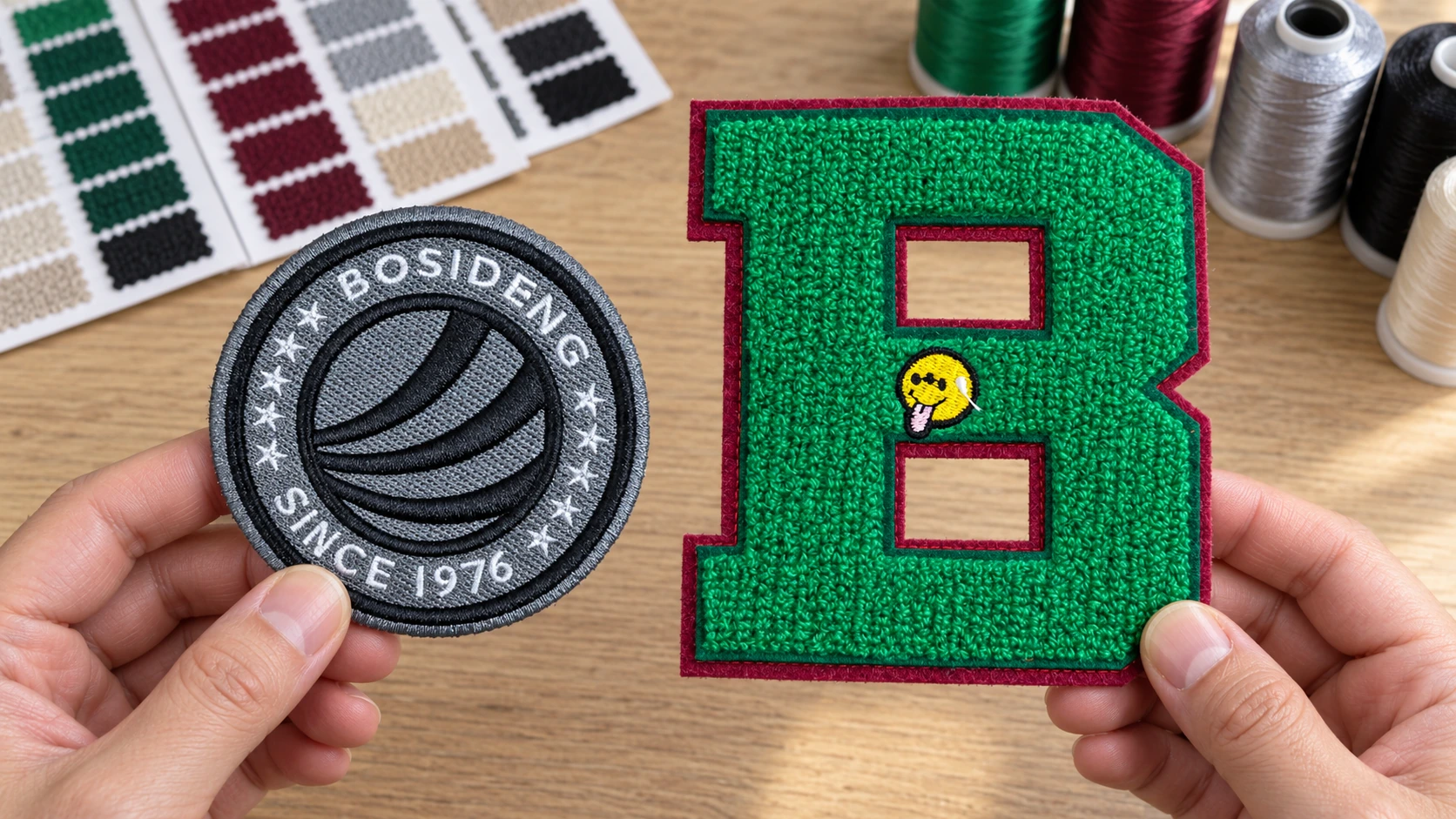
How do you choose between the two styles? Chenille builds its surface from loops of yarn that stand a few millimeters off a felt base, and those loops need room. In our production the smallest chenille letter is about 30 mm tall, while embroidered lettering works at a fraction of that. If the design is an 8-inch varsity letter, chenille is the natural choice. If it is a 3-inch chest logo with a tagline, embroidery is — or the tagline moves to an embroidered layer on a chenille patch.
Once the size fits, most chenille vs embroidered patches decisions come down to three questions: is the design built from large, flat shapes, how heavy is the garment, and how often will it be washed? Price follows from all three.
Two machines, two kinds of stitch
Chenille is not thick embroidery. A chenille head uses a needle with a hook instead of an eye; a looper under the needle plate pulls the yarn up one loop at a time, and there is no bobbin, as Wilcom’s overview of traditional chenille describes. The machine sews two stitches. Moss (loop) stitch fills shapes with standing loops, which is the fuzzy part. Chain stitch lays a flat, linked line for outlines and locks the edges of the moss.
An embroidered patch is stitched with ordinary thread and a bobbin, always over a paper or iron-on adhesive backing that supports the stitches from below: running stitches for outlines, satin columns for lettering and borders, fill stitches for larger areas. The surface is flatter and sharply defined, and a fine thread can form far narrower shapes than a looped yarn.
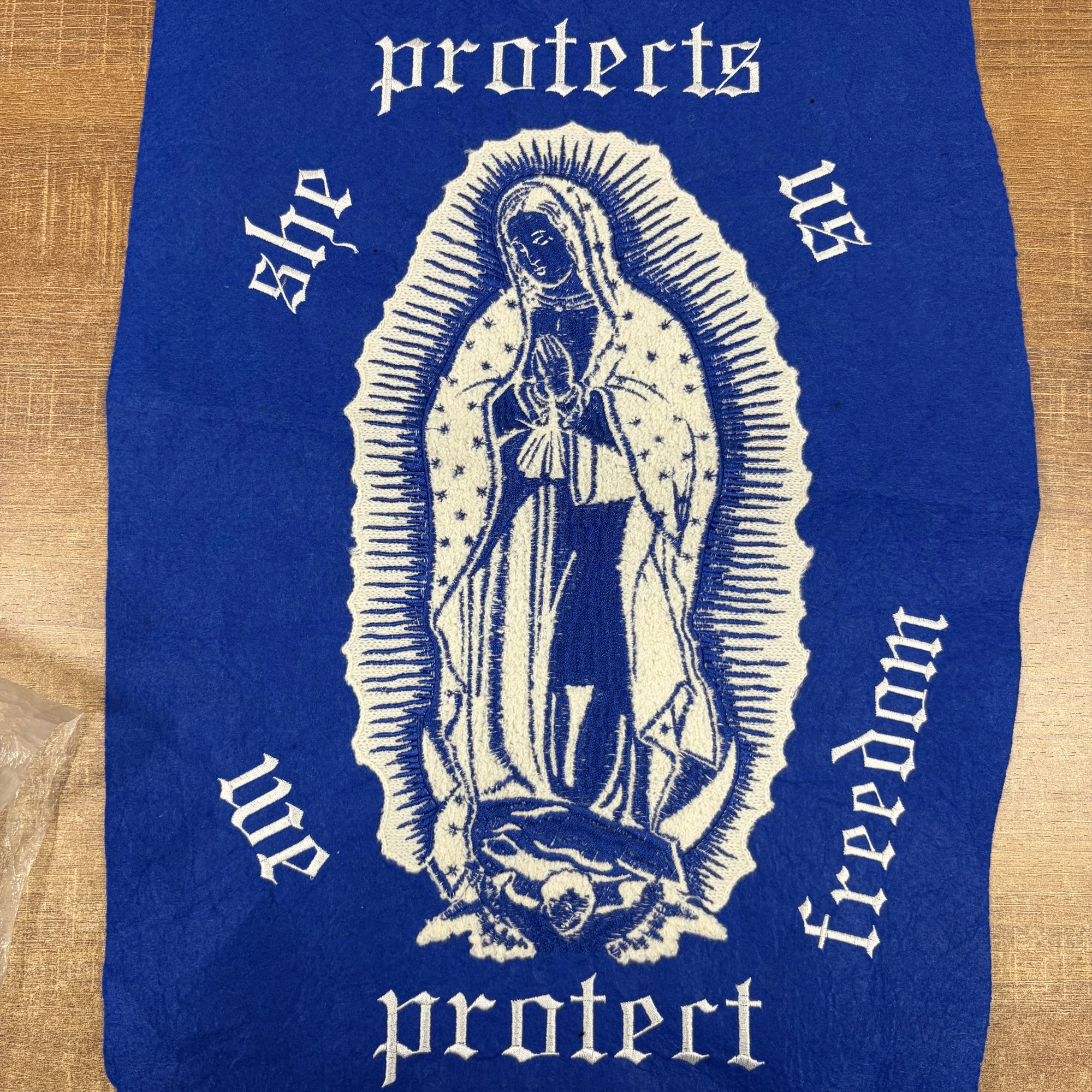
Two practical consequences follow. An embroidery file cannot simply be switched to chenille; the shapes have to be redrawn for the space the loops take up. And because some machines pair a chenille head with a standard embroidery head — Tajima’s TCMX mixed type is one example — a single patch can carry both constructions. That is how most varsity letters with names and years are made.
Chenille also has a setting embroidery does not: loop height. The machine adjusts needle height to set how tall the loops stand, from low and compact to high and plush, and the same design reads quite differently at each. Loop height is not visible on a digital proof, so it is one of the things to judge on the physical sample. We sew chenille on our own chenille machines, so the chenille and the embroidered details of a patch are made in the same factory.
The size floor: what chenille can and cannot draw
Loops have a width and height of their own, so chenille has a minimum size for everything it draws. In our production, chenille letters need to be about 30 mm tall or more, and the smallest chenille element is about 3 × 3 mm. Those figures line up with published specs from other large patch makers, one of which also sets internal cut-outs at 10 mm. Some suppliers go further, asking for standalone chenille letters of at least 2 inches and warning that patches under 3 inches lose most of the chenille texture.
Many embroidered vs chenille patches comparisons stop at “chenille can’t do small text.” The useful part is how much larger it has to be. For embroidery, our limit is stitch width rather than letter height: at 3 mm, stitched detail only barely holds its shape, and detail that has to read clearly usually needs about 4 mm. A chenille letter needs several times that.
In practice, the artwork changes in predictable places:
- Counters — the holes inside “A”, “O” and “R” — close up first. Open them wider or choose a heavier block font.
- Thin strokes, outlines and small icons belong to chain stitch or embroidery, not to moss.
- A mascot works in chenille as a silhouette of large color areas; eyes, teeth and fine linework go into an embroidered layer.
- Shrinking a back patch for the chest breaks the chenille version long before it breaks the embroidered one.
Splitting one design between yarn and thread
Many chenille patches are not pure chenille. The classic letterman letter is a chenille block on one or two layers of felt, with the name, sport or year embroidered on the felt beside or within it. Each part goes to the construction that can draw it.
Take the script patch below. The lettering is chenille: royal-blue letters outlined in gold, with the second word in white. The Daruma doll at the lower right has eyes, eyebrows and a flower pattern far too small for loops, so once the chenille is done, the same machine embroiders the doll directly on the felt and then stitches a white embroidered border around the whole outline. No felt or base fabric is left showing.
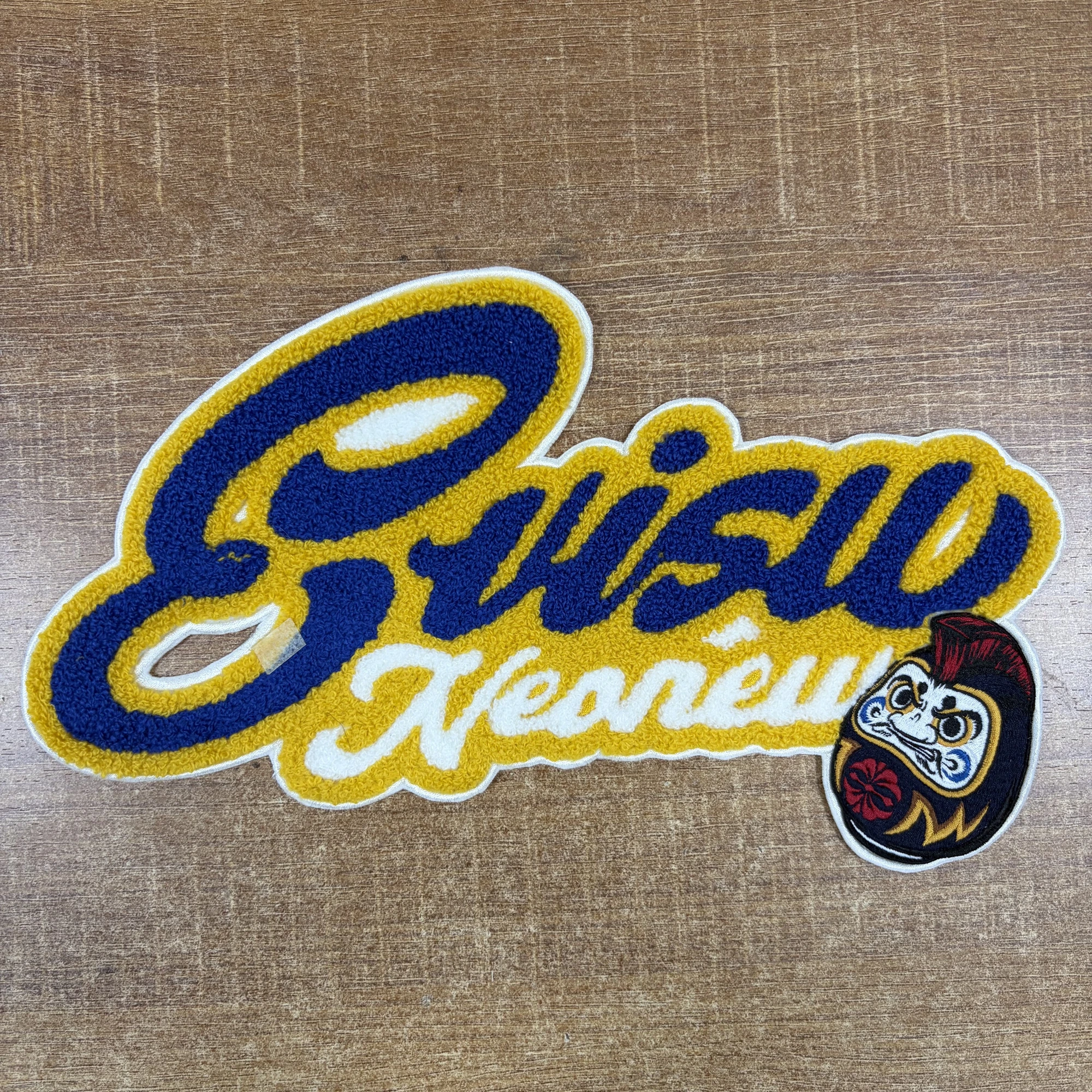
In our production the embroidered details are stitched on the felt, and there is no fixed ratio between chenille and embroidery. The practical limit is width, the same as for embroidery. One machine head covers a field of roughly 40 cm (about 16 inches), so a patch design should stay within that. Wider artwork has to be stitched in sections and joined, which suits garment embroidery better than patches. Some suppliers set their own hybrid rules, such as a cap on how much of the patch can be embroidered, so check before the artwork is final.
The edge belongs to the same decision. A single felt border leaves a visible margin of felt around the chenille. A second felt layer adds a contrasting frame without extra stitching. An embroidered border gives a cleaner, firmer edge. Our chenille patches are offered with single felt, double felt or embroidered edges.
Color: felt does part of the work
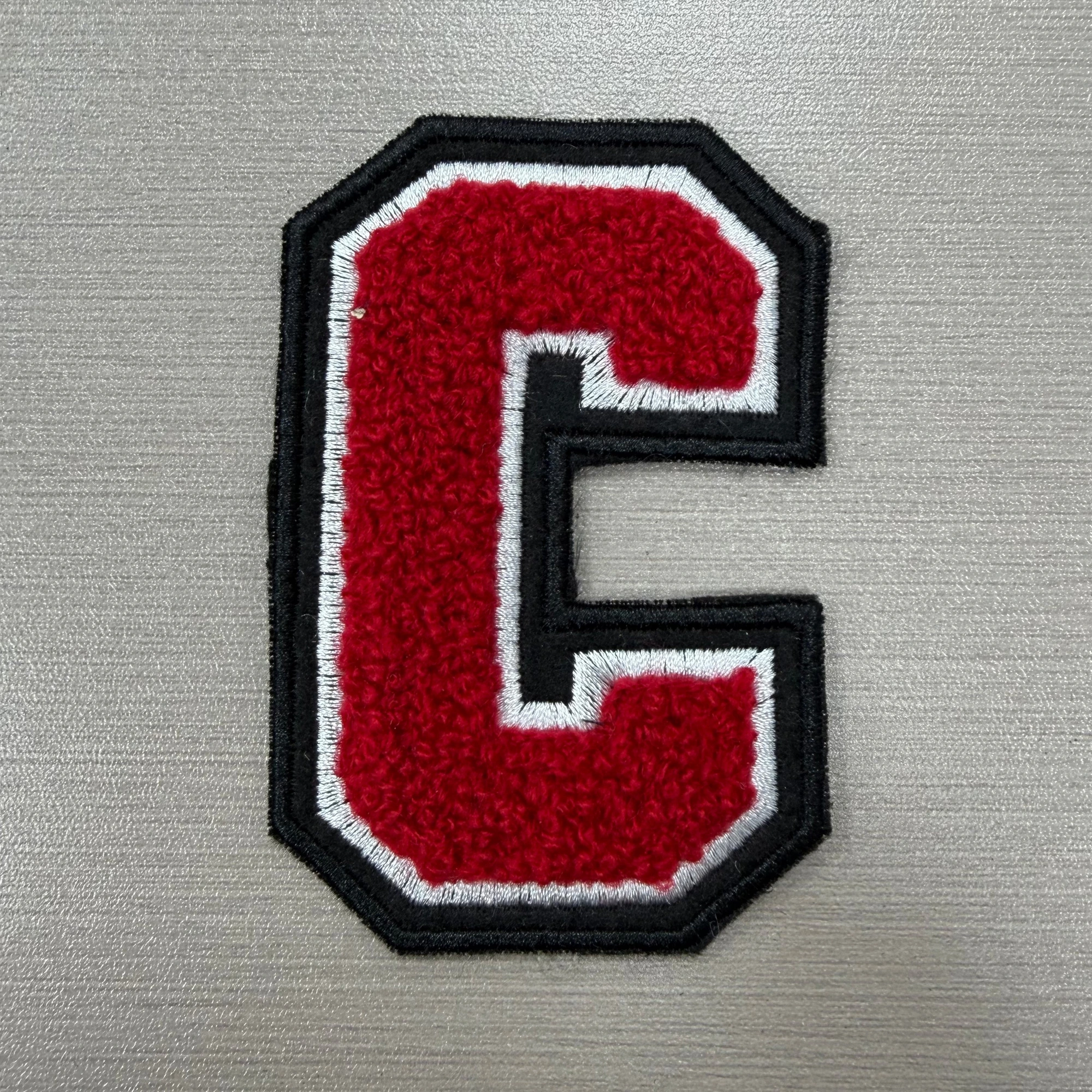
Embroidery builds every color from thread, so a design can carry many thread colors and small color changes. Chenille works with fewer yarn colors and lets felt carry the rest. We run chenille in up to about six yarn colors per patch. Another supplier sets the same cap of six; a third says most chenille patches use only one to three yarn colors plus the felt.
Felt counts as a color in its own right. A gold letter for a navy jacket might use gold yarn, a white inner felt and a navy outer felt: three colors from one yarn.
Chenille cannot blend colors. Gradients and shading have to become flat color areas or move to an embroidered layer, where stitch techniques can blend thread colors into a smooth gradient. If a logo depends on photographic shading, compare printed patches instead.
Garment weight, attachment and washing
A chenille patch is thick and heavy next to embroidery. Supplier specs describe finished chenille at about 3 mm thick, with loops standing 3–5 mm off the felt. That weight suits wool varsity jackets, heavyweight hoodies and bags. On a lightweight polo or a stretch performance shirt it drags the fabric and stands away from it, while embroidery sits flatter and follows the garment.
Sew-on is the traditional attachment for chenille and still the safest on a varsity jacket. Heat-applied chenille exists, but the adhesive needs heat the garment can take: one heat-applied chenille supplier recommends it for cotton, polyester and blends, and not for wool, fleece, some nylons, silk or leather.
Our chenille patches can take iron-on (heat-activated adhesive), hook-and-loop, sew-on or peel-and-stick backing. On garments with a napped or fuzzy surface, such as fleece or brushed wool, we recommend sewing only: neither the iron-on adhesive nor a hook-and-loop panel holds reliably on that surface. Iron-on suits smooth cotton and poly hoodies and tees; peel-and-stick backing is for hard goods rather than clothing.
The loops are also where chenille wears. Washing and abrasion can flatten the pile or shed fibers, while embroidered thread lies flat and is less exposed. Published wash ratings for heat-applied chenille range from 25 to 52 domestic cycles depending on the supplier, which says more about each adhesive and test than about chenille itself.
For uniforms and other garments laundered every week, embroidery is the lower-risk choice. We advise against heavy-duty machine washing for chenille: even when the patch is sewn on permanently, repeated aggressive washes change the chenille surface. A gentle, cold, inside-out cycle, air-drying and a soft brush for flattened loops keep it looking right for longer.
Chenille vs embroidered patches on price: why large chenille often costs less
Most published comparisons put chenille above embroidery on price. They point to slower chenille heads (Tajima lists chenille embroidery at up to 750 rpm against 1,000 rpm for standard embroidery) and to the extra felt, cutting and border work.
In our production it works the other way. At the same size and quantity, chenille comes out slightly cheaper than embroidery, and the difference grows with the patch. Embroidery cost follows stitch count, and a fully filled embroidered back patch carries a very large one, while chenille yarn covers the same area with far fewer stitches. That is also why many large embroidered patches use twill or felt to cover large areas instead of filling them with thread, an option shown under coverage on our custom embroidered patches page. Twill is a design choice, not a standard base: a fully embroidered patch uses none, and only when it needs more thickness is twill, a heavier backing or felt added underneath.
In any chenille patch vs embroidered patch quote, compare both on the same finished size, quantity, colors, border and backing. The minimum order is 200 pieces. Every PatchCraftPro order goes through a pre-production sample before the run; for chenille, that sample is where you check pile height, felt colors and how the embroidered details sit.
Our custom chenille patches and custom embroidered patches pages show the border and backing options for each.
FAQ
Is “faux chenille” the same as a chenille patch?
No. Faux chenille is stitched on a standard embroidery machine, using a heavier stitch technique to imitate the look of chain stitch. True chenille loops rise out of the felt and need a chenille head. Faux chenille feels flatter because it is still embroidered in polyester thread, while chenille has raised, plush yarn loops. The two are quite different, so ask which one is being quoted.
Can a chenille patch go on a cap?
Only in limited cases. A structured cap front can carry a small, simple chenille shape, but at the usual 2–3 inch cap size the loops leave little room for lettering, and a soft crown will not support the weight well. For most cap logos, embroidery or a woven patch gives a cleaner result.
Not sure which way your design falls? Send your artwork and requirements for a quote with the finished size and the garment, and we will tell you what each construction can keep.
Ready to source your own custom patches?
Tell us about your patch requirements and get a free digital proof and quote — no obligation, no pressure.
Your best custom patch manufacturing partner