
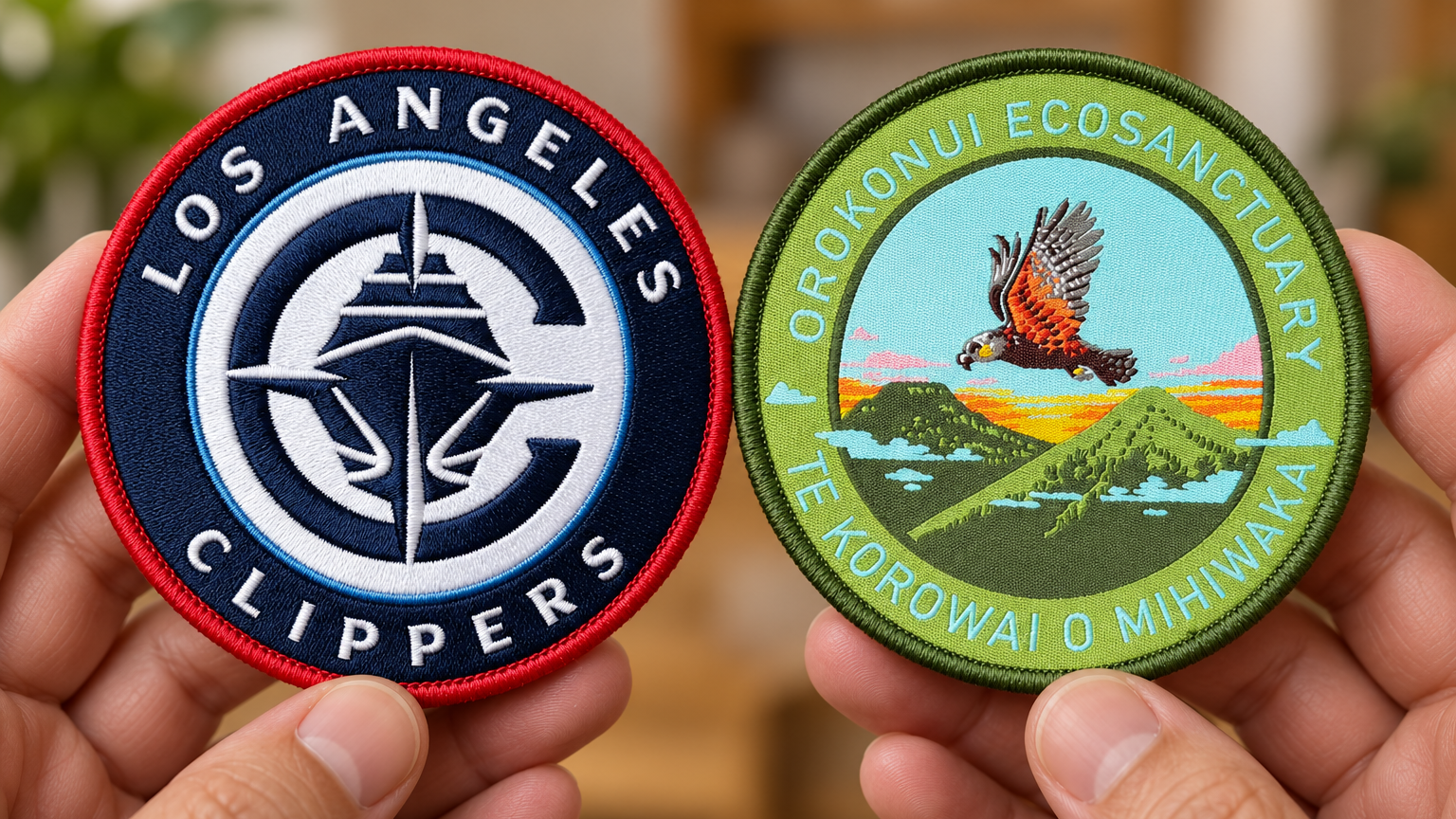
Embroidered vs woven patches come down to one question: can the smallest element on your artwork survive as stitches at the size you are ordering? If your logo has small type, fine outlines or tight spacing, choose woven. If the design is bold, will be read from a distance, or needs a raised surface you can feel, choose embroidered.
The difference between woven and embroidered patches starts with construction. Embroidery builds the design on top of a base with stitches. Weaving makes the design part of the cloth itself. That one difference decides thickness, the finest detail you can hold, how the patch sits on a garment, and how the cost is built.
How Embroidered vs Woven Patches Are Built
An embroidered patch is a stack of layers. Thread is stitched over a base, with an underlay behind it to keep the stitches stable. In our production that underlay is always there, either paper backing or a fusible layer. Twill is a design choice rather than a requirement: on a fully embroidered patch the thread covers everything, and on large designs felt or twill can take the place of part of the stitched area to keep the stitch count down.
A woven patch has no base fabric. Fine colored yarns are interlaced on a jacquard loom, which controls individual warp yarns so the pattern forms inside the weave (Britannica explains how jacquard weaving works). Every part of the surface is woven yarn, so there is no option to leave a base fabric showing.
| Embroidered patch | Woven patch | |
|---|---|---|
| How the design is made | Stitches built up on an underlay and base | Yarns interlaced on a loom; the design is the fabric |
| Surface | Raised, with visible stitches and sheen | Flat and smooth, close to a clothing label |
| Finest detail | Limited by stitch width | Finer yarns hold smaller text and thinner lines |
| Thickness and feel | Thicker and stiffer | Thin and flexible |
| Base fabric showing | Possible with partial coverage | Not possible; the whole surface is woven |
| Cost behavior | Rises with stitch count, coverage and colors | Usually lower for the same artwork and size |
Check 1: Measure the Smallest Thing on Your Artwork
A common wrong order starts here. A buyer picks embroidery because it is the familiar option, and the tagline under the logo comes back as a filled-in line. The opposite also happens: someone expects a raised badge, orders woven, and receives something that looks like a garment label.
On an embroidered patch, every letter stroke and line is a column of stitches with real width and height. In our digitizing, a stroke around 3 mm wide only just holds its shape; about 4 mm is what it takes to stitch it cleanly. We check this in the digitizing software at the finished patch size, not on the artwork file at screen size. Woven yarns are much finer, so woven patches keep smaller text and thinner lines legible. Weaving has a floor too: hairline strokes and very small enclosed shapes can still close up between yarns, and no single letter height works for every font. That is why woven artwork is also checked at its finished size.
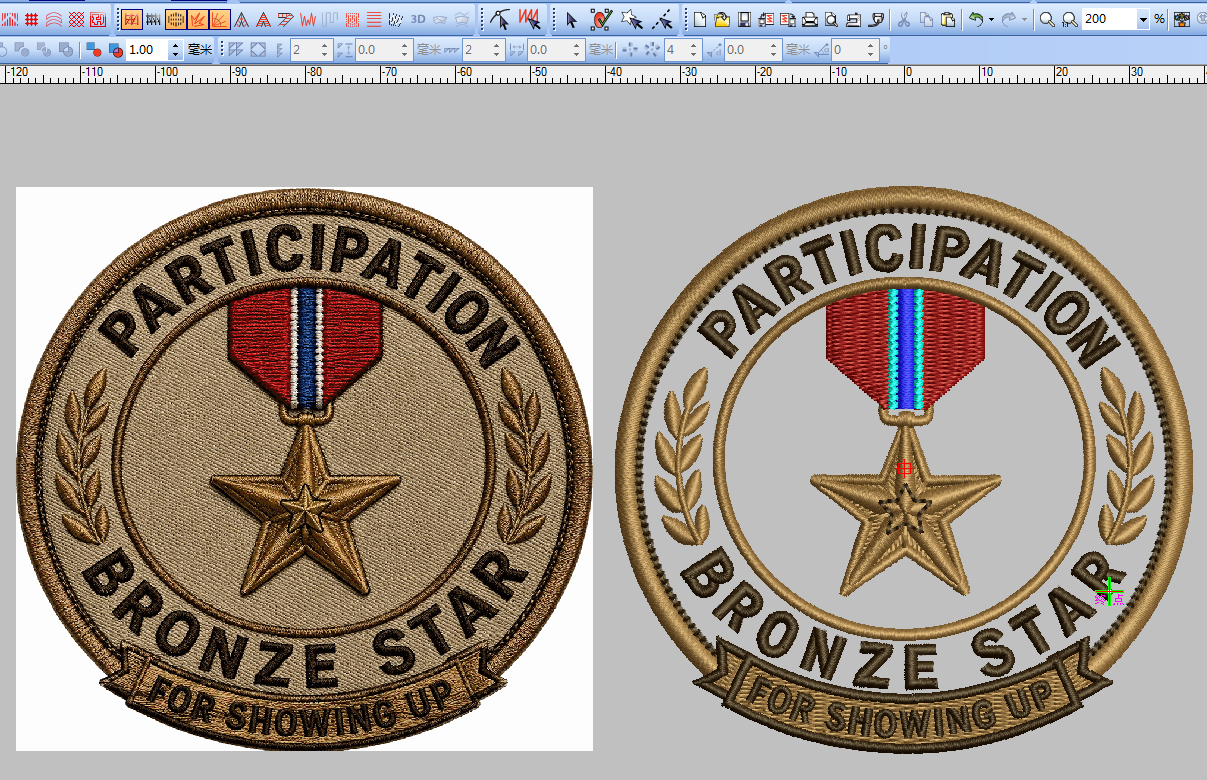
Letterform matters as much as size. Serif, script and decorative fonts have thin strokes and small counters that close up earlier than a bold sans-serif at the same height. Raised stitches also make a thin, geometric logo look heavier than the brand file. When a design misses the embroidery limit, there are four routes:
- Switch to woven patches that keep fine lettering readable.
- Enlarge the patch, or enlarge only the text. Stitch the small text with a finer 75D thread. This helps, but we do not promise that every font will read at 4 mm.
- If there are too many colors and details, stitch a base color first and print on top of it.
- If the design depends on shading rather than lines, move to a printed patch.
Check 2: Decide How Far Away It Will Be Read
Raised stitches catch light and throw small shadows, so an embroidered patch still reads across a room, on a sleeve in a crowd or in a team photo. That is why police, fire, club and team patches have stayed embroidered for so long. A woven patch reads best up close. Low-contrast colors that look refined on a woven hat-side label can disappear at ten feet.
Neither one is automatically the premium choice. A woven label on a minimalist overshirt can look more expensive than any badge, while the same woven patch on a heavy canvas work jacket can look too flat for the garment. If buyers will judge the product in hand, woven usually protects the logo better. If the patch has to identify a person or a team at a distance, embroidery does that job.
Check 3: Match the Patch to What It Is Sewn On
A thick, stiff patch needs a garment that can carry it. Structured cap fronts, denim, canvas bags and work jackets support embroidery without buckling. On a lightweight tee, a knit beanie or stretch performance fabric, the same patch can sit stiffly and pull at the fabric around it.
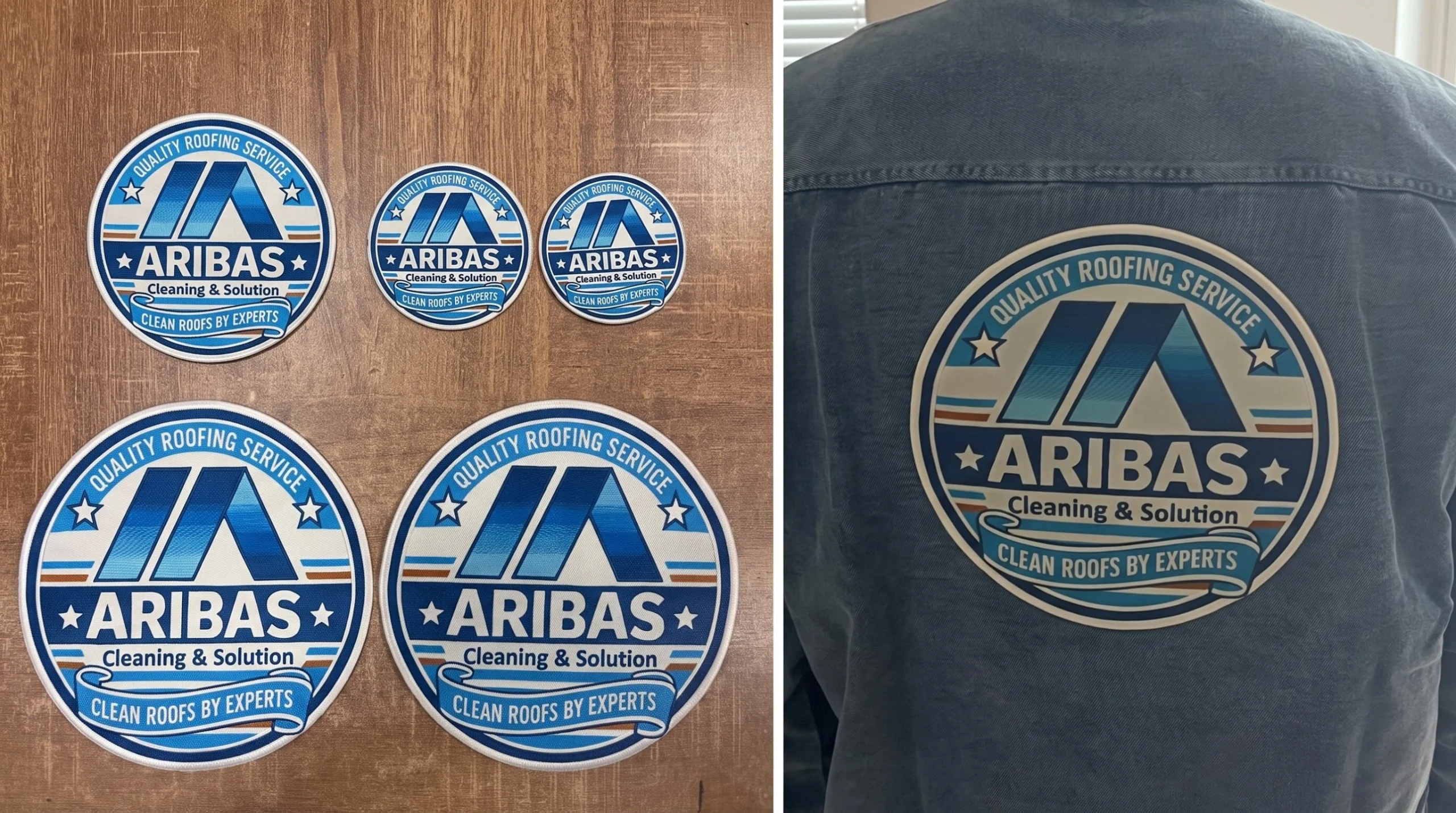
Woven patches are thin and flexible, so they follow soft or curved surfaces and lie flat under a collar or on a bag panel. That makes them the usual choice for brand labels on knitwear, bags and the side of custom hat patches, while the front panel of a structured cap is often embroidered. Backing does not change this decision. Both types can be left plain for sewing, or given iron-on, hook-and-loop, peel-and-stick or magnetic backing, one backing per patch.
Check 4: Plan the Colors and the Edge
Most embroidered designs use 1 to 12 thread colors, and very few go past 15, because the machine head carries a fixed set of needles. Each added color adds cost. Embroidery can blend colors with stitch direction and density, and a photo-like area can be stitched in one color and printed on top. This carries complex detail and a large number of colors while keeping the embroidered look, and sublimation, the print method used for that layer, is now very widely used.
Woven patches build color from the yarns loaded on the loom, so they handle many solid color areas in a small space. They are not a photographic process, though. If the artwork relies on smooth gradients or shading, printed patches are the better fit. The number of yarn colors is one of the factors behind woven setup and price, so keep only the colors the design actually needs. Thread and yarn colors are physical dyes, so match them with Pantone references rather than screen colors.
The edge is part of the design. A merrowed border wraps thread around the outline, so it cannot follow inside corners or sharp inward points. For standard shapes, we usually finish both embroidered and woven patches with a merrowed border. Irregular shapes are laser-cut or hot-cut and then finished with an embroidered border. Keep small text clear of the edge, because a border takes up width. A poorly finished cut edge can fray on either type. If you are still deciding between flat finishes, our printed vs woven comparison covers that next step.
Check 5: Compare the Same Spec, Not Two Price Lists
We weave our woven patches in our own factory. For the same artwork, size and quantity, they cost less than embroidered ones, and woven is the most economical route for complex multicolor designs. Embroidery is priced by the work in the stitches: stitch count, the percentage of the base covered, and the number of thread colors. A design with partial coverage, where the base fabric shows through, uses fewer stitches than a fully covered one.
If you are pricing woven or embroidered patches from several suppliers, expect their pricing models to differ; some price woven higher than embroidered. The only fair comparison is two quotes on one specification: same artwork, finished size, quantity, edge and backing. Then compare the totals, not the headline unit price.
When to Use Both, and How to Confirm Before Production
You do not always have to pick one. A single patch can combine both methods: a woven base carrying embroidered details or raised satin-stitch lettering. It is common on outdoor and backpack patches, where the woven area holds the fine graphic and the stitched lettering adds texture. It is produced and quoted as one finished patch.
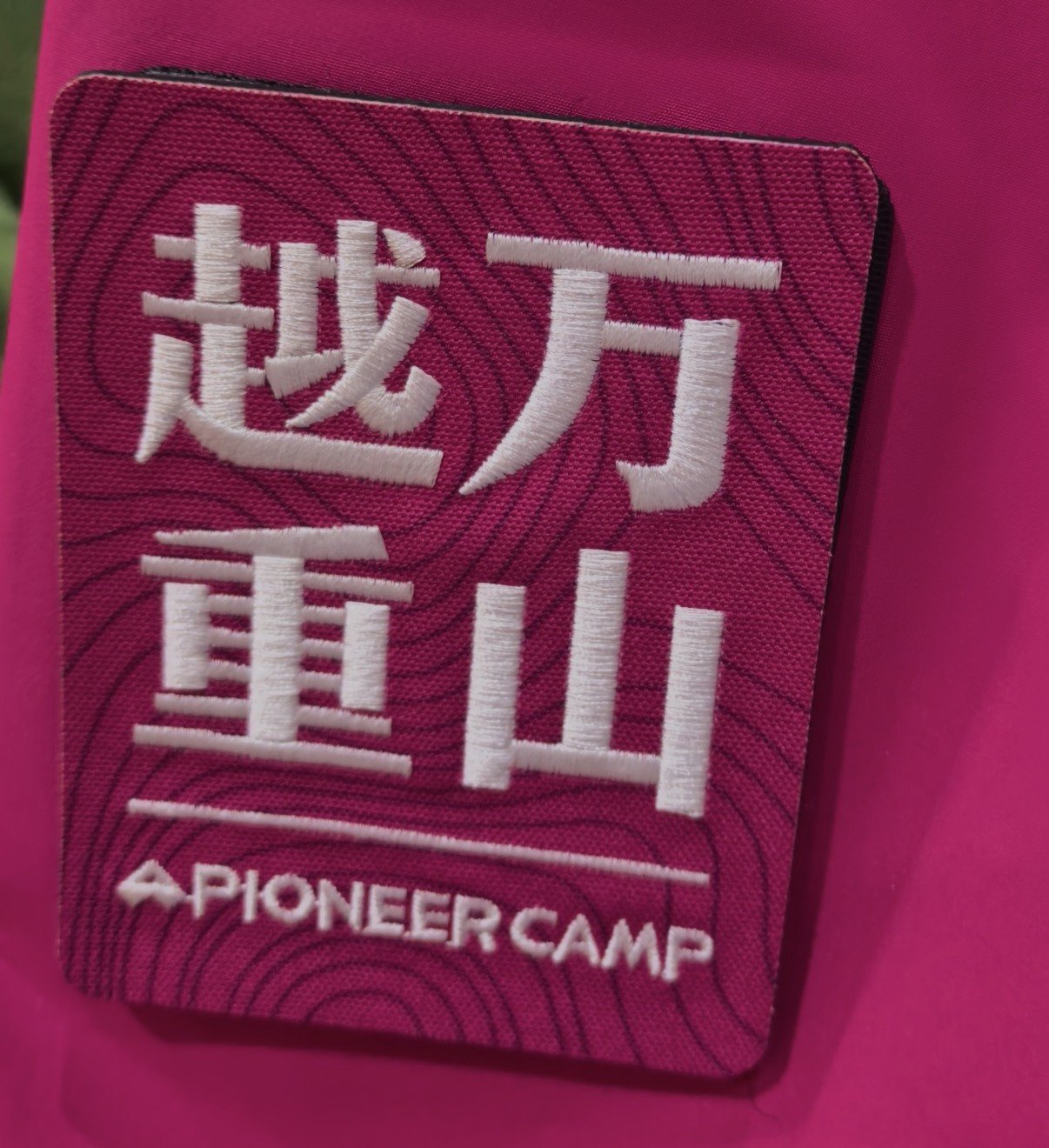
Many brands also split by product. They use woven labels on hats, bags and knitwear, and embroidered patches for outerwear and merch that needs presence. For a uniform program, a stitched crest with a woven name or sponsor patch keeps both readable. Keep the same Pantone references across both so the brand colors stay consistent. Without Pantone references, we can match colors from an image, but screen settings and the human eye both introduce some color difference, so the colors will come close to the image but cannot be guaranteed to match exactly. The pre-production sample is the reference.
Confirm the choice in two steps. The free digital proof checks layout, text and colors against your artwork, but it cannot show thickness or texture. Every order then goes through a pre-production sample, so you see the real stitches or weave, the edge and the color before bulk production. Changes to the sample and the digitized file are free until production starts. If you have a logo with small text and are unsure which way it should go, send it for a quote and ask for both options on the same spec.
FAQ
Is woven the same as embroidered?
No. Both use thread, but embroidery stitches the design onto a base, while weaving creates the design as the fabric itself. That is why one is raised and the other is flat.
What is a damask patch?
It is a woven patch made with a denser weave, which holds finer detail. Some suppliers use “woven”, “soft woven” and “damask” for the same flat-woven construction, so ask what you are being quoted.
Do embroidered patches fray faster than woven ones?
Only partly. The raised stitches and the border of an embroidered patch are more exposed to snagging. A woven patch has no raised stitches, but its cut edge can fray if it was not finished well. A properly finished edge matters more than the patch type.
Can a woven patch get the same backing as an embroidered one?
Yes. Sew-on, iron-on (heat-activated glue), hook-and-loop, peel-and-stick and magnetic backings can go on either type. Backing is chosen separately from woven vs embroidered, and each patch takes one backing.
Ready to source your own custom patches?
Tell us about your patch requirements and get a free digital proof and quote — no obligation, no pressure.
Your best custom patch manufacturing partner