
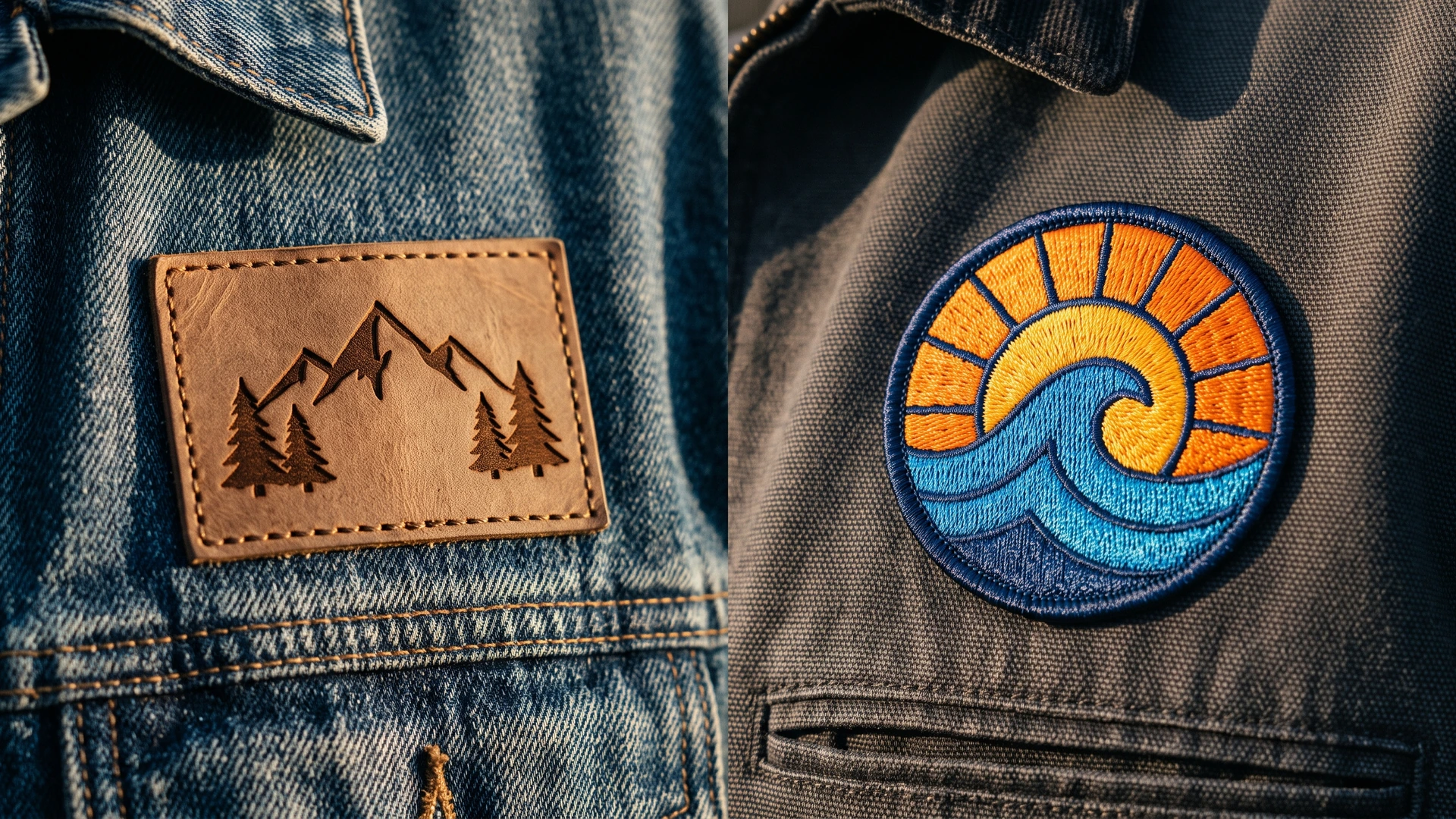
Start with the finish the logo needs and the garment it will sit on. In most leather vs embroidered patches decisions, that settles it. A leather patch puts the logo into a 2–4 mm piece of genuine or faux leather, pressed, engraved or printed, and it holds finer lines than thread can. An embroidered patch builds the logo from raised, textured thread. How often the garment is washed then decides between genuine and faux leather, and the price gap comes mostly from tooling and the leather itself.
Leather patches are cut and marked; embroidered patches are stitched
A leather patch starts as a piece of genuine or faux leather cut to shape; we use both, usually 2–4 mm thick. The logo then goes into or onto the surface. A laser burns away a thin layer. A die presses it in (debossing) or pushes it up (embossing). High-frequency embossing uses a die and high-frequency energy to raise letters or shapes from the surface. Color fill puts ink into recessed areas, and UV printing prints the artwork directly on top.
An embroidered patch is built rather than marked. The machine lays thread stitch by stitch over a paper or iron-on adhesive backing that keeps the stitches stable; twill, felt or another fabric is added only where the design calls for a fabric base. The logo stands up from the surface in as many thread colors as the design needs, within the supplier’s limit. Most designs use 1 to 12 thread colors and rarely more than 15: an embroidery head usually carries 12 to 16 needles, one color each, so more colors mean stopping to change thread mid-run.
That difference runs through everything below. On leather, the material is part of the design: its color, grain and thickness show in the finished patch. On embroidery, the thread covers the base, so the base matters only where it is left showing.
The two can also share one patch. We can embroider on leather and add stitched lines, so a leather patch can carry a stitched name or outline next to a pressed or engraved logo.
Leather holds finer detail; color comes from printing
In our production, laser engraving and debossing both hold characters down to 1 mm tall and lines down to 0.3 mm wide. Embroidery cannot go that fine: stitched detail needs a stitch width of about 3–4 mm to read clearly, and anything smaller is better woven. If a logo needs very small text, leather or a woven patch keeps it; thread does not.
Color works the other way round. Laser engraving, debossing, embossing and high-frequency embossing all produce a one-tone mark: a darker or raised version of the leather itself. Color comes from a second process. Color fill adds ink to recessed areas, and UV printing reproduces full-color artwork, gradients included, on the leather surface. Embroidery builds color from thread, one thread color after another, but stitch techniques can blend those colors into a smooth gradient with more texture than print. Every extra color adds to the embroidery cost.
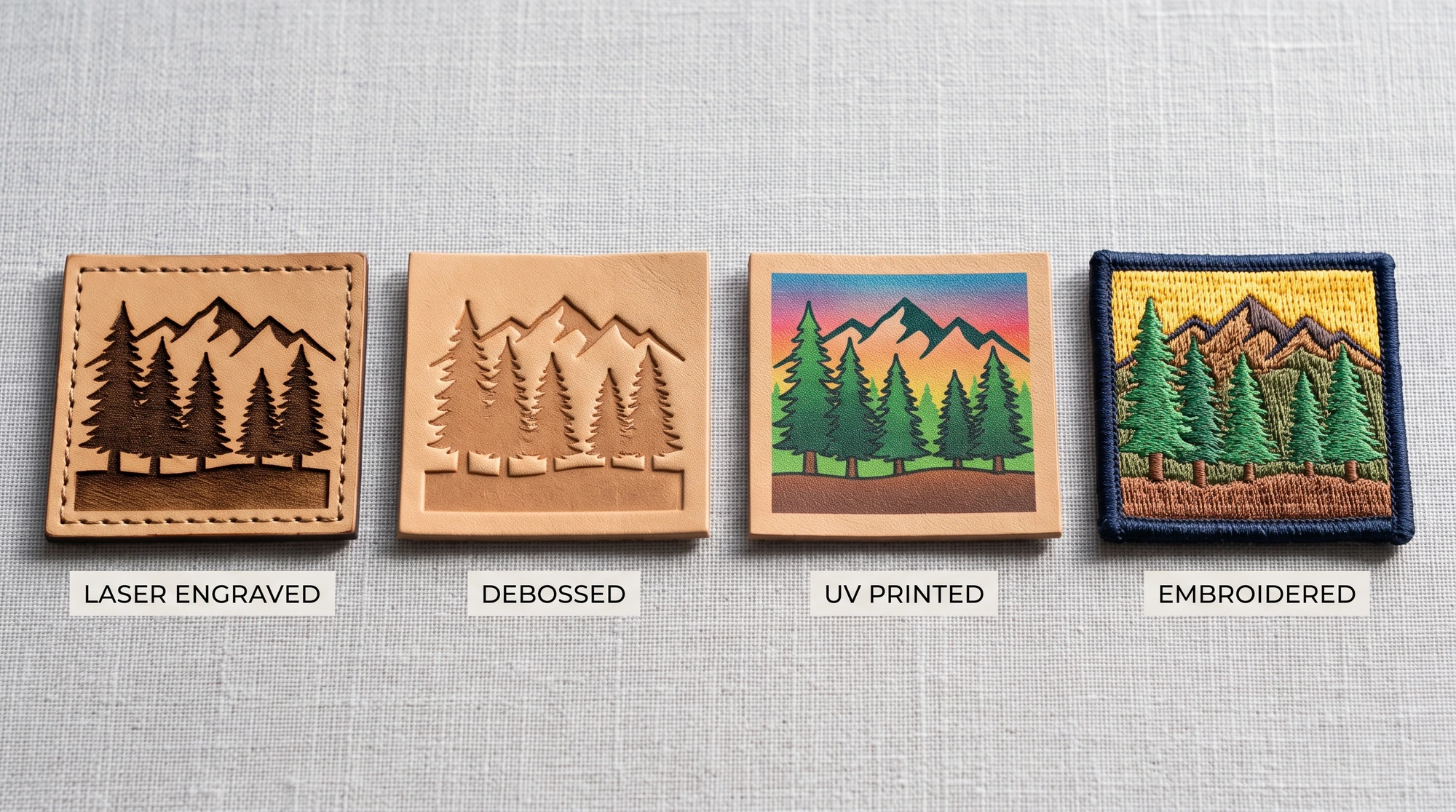
The textures differ too. UV-printed color sits flat on the leather; embroidered color stands up in thread. In a leather patch vs embroidered patch choice, a logo with gradients or photographic shading gets the smoothest color transitions from UV printing on leather. A newer embroidery technique gives a fuller result: the patch is embroidered in one color and the artwork is printed over the stitches, so the image keeps a raised, stitched feel.
Genuine or faux leather: washing decides
Genuine leather is a natural material. Grain, thickness and color vary from hide to hide, and it darkens and softens as it is handled. Faux leather keeps the same look across a production run and usually costs less.
Washing is where the two separate. Water does less harm to genuine leather than drying does: as it dries it loses oils, and if it dries in the sun or next to a heater it can stiffen. For garments washed often, we look first at faux leather that comes with a defined care specification; one supplier, for example, rates its heat-applied faux leather patches for at least 52 home washes at up to 40°C (104°F). Genuine leather fits garments where the natural grain matters and washing is less frequent. In practice we use both, and leather patches on jeans are worn and washed with them for years.
Which garments suit each, and how to attach them
- Leather suits jeans, denim and canvas jackets, heavy outerwear, tote bags and backpack panels.
- Embroidery suits streetwear, workwear, uniforms, polos, hoodies and other garments where a stitched look fits the brand.
- Neither sits well on light T-shirts or stretch performance tops. A 2–4 mm leather patch, or a dense embroidered one, drags thin fabric.
Our leather patches can be sewn on, ironed on, or backed with hook-and-loop or adhesive. Iron-on works on genuine leather too. The press temperature is what matters: wet leather shrinks suddenly and permanently once it passes its shrinkage temperature, which SATRA puts at no higher than about 85°C for vegetable-tanned leather and around 100–120°C for chrome-tanned leather. We set the press for leather patches so the leather is not damaged. Adhesive backing suits hard goods rather than clothing.
For sewing, one supplier’s spec leaves a margin of about 3 mm between the stitch line and the patch edge so the needle stays clear of the design. On a jacket that is handled every day, a sewn edge also resists lifting better than a heat-applied one.
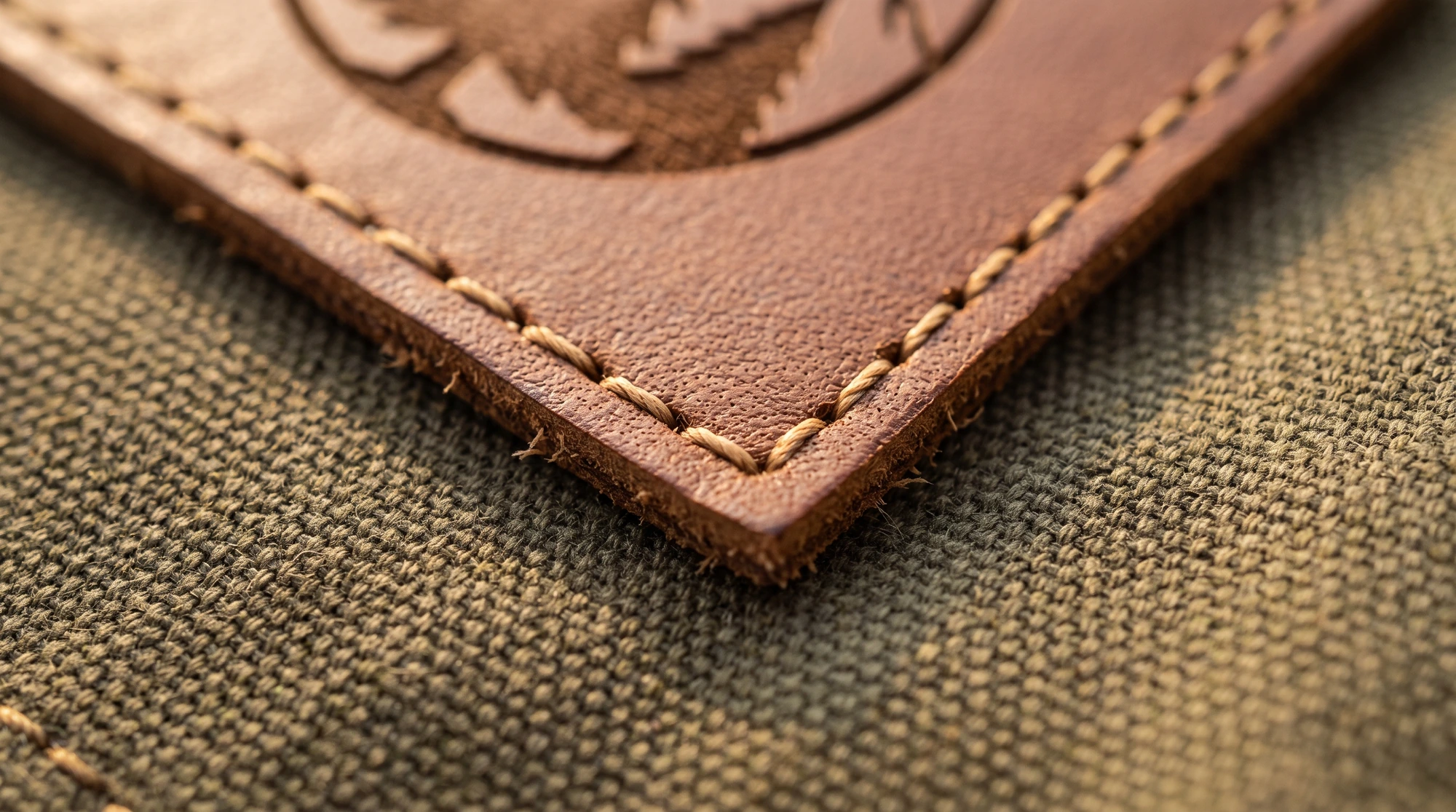
Caps raise their own questions — a curved front panel and constant contact with sweat — and are best judged separately from apparel.
Leather vs embroidered patches on price
Leather patches usually cost more than embroidered ones. Like PVC patches, they carry a tooling charge, because pressed and raised finishes need a die made for the design. The leather itself and the marking processes also cost more than thread. Embroidery needs no die; its cost follows stitch count, so large, densely filled designs cost more.
In any embroidered vs leather patches quote, compare both at the same finished size, quantity, backing and edge. Our minimum order is 200 pieces, and every order starts with a pre-production sample; for leather, that sample shows the real leather tone and how deep the engraving or pressing sits.
Our custom leather patches and custom embroidered patches pages show the finishes and backings for each.
Not sure which way your logo falls? Send your artwork for a quote with the garment and how often it will be washed, and we will tell you which patch keeps it intact.
Ready to source your own custom patches?
Tell us about your patch requirements and get a free digital proof and quote — no obligation, no pressure.
Your best custom patch manufacturing partner