
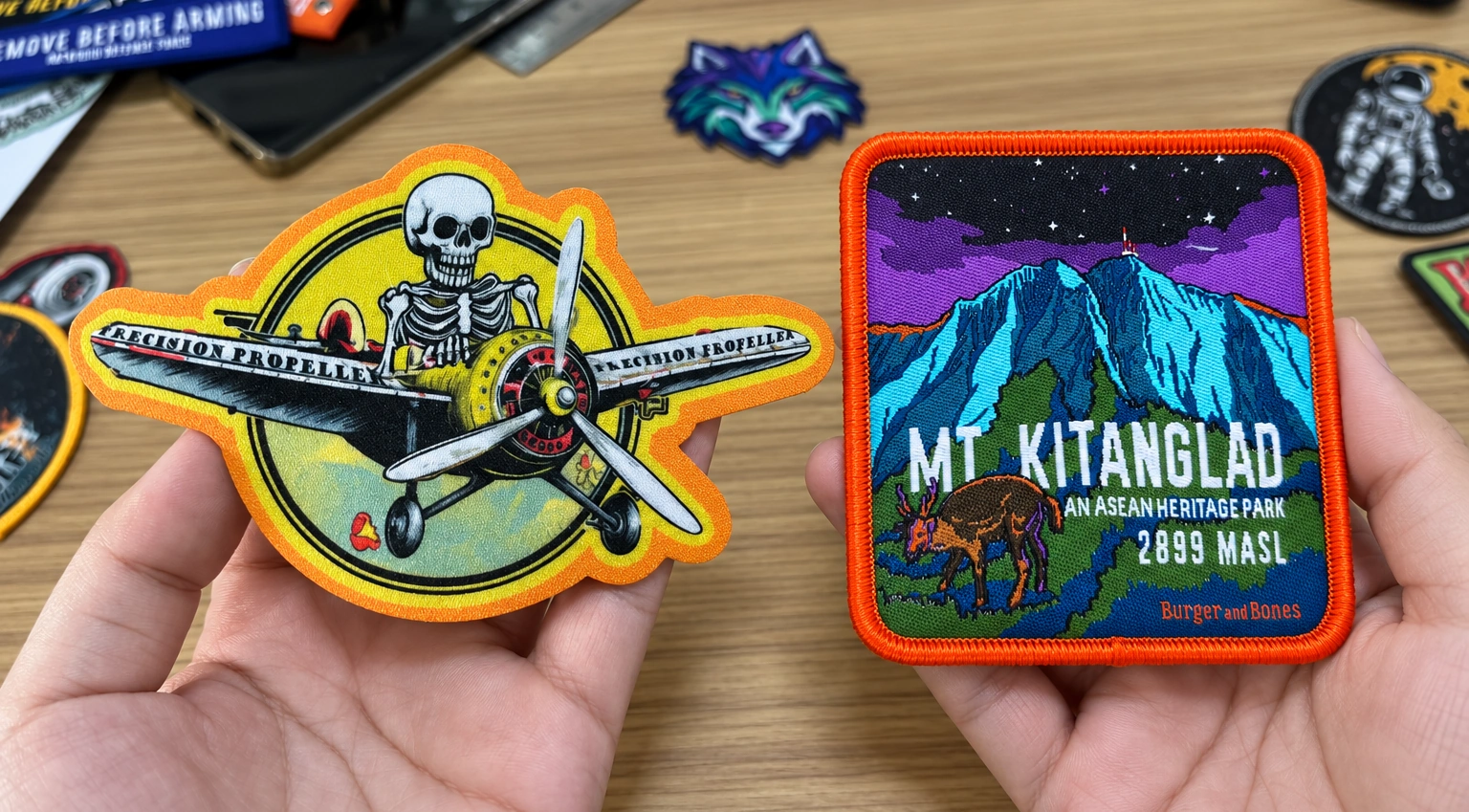
Look at the artwork first. If it depends on a photograph, a gradient, soft shadows or a painted illustration, start with a printed patch, because only printing lays down continuous tone. If it is a logo of solid colors with small lettering and thin lines, start with a woven patch. Fine yarns hold that detail, and the result has a real textile surface.
The choice between printed vs woven patches is not about which is sharper. Both handle fine detail well. What differs is how each one builds color: a weave can only use the yarn colors loaded for that design, while a print can blend any color the ink set can reach. That one difference drives most of what follows, including price.
Printed vs woven patches at a glance
| Difference | Printed | Woven |
|---|---|---|
| 1. How the image is made | Dye or ink applied to a fabric base, usually white or light polyester | Fine colored yarns interlaced on a loom; the design is the fabric |
| 2. Artwork it suits | Photos, gradients, shading, illustrations | Solid-color logos, lettering, line art |
| 3. Small text and thin lines | Limited by the source file, contrast and the edge | Limited by the yarn grid; very small text needs a finer weave |
| 4. Color | Blended tones; white usually comes from the base fabric | A fixed set of yarn colors per design; gradients are suggested, not blended |
| 5. Surface and feel | Smooth and flat; the base fabric may show, but colors blend instead of changing yarn by yarn | Flat but visibly woven, with a slight yarn sheen |
| 6. Price in our production | The most expensive of the three main patch types | The least expensive |
How each patch is made
A woven patch comes off a jacquard loom. Colored yarns are interlaced so that each color rises to the surface where the design needs it, and the pattern becomes the fabric itself. There is no base cloth underneath. High-definition weaves use very fine filament yarn, around 50 or even 30 denier, which is why woven patches hold detail that embroidery thread cannot.
The loom also sets the limits. Every color in the design is a separate yarn, and suppliers publish limits that range from about six to twelve yarn colors per design; we confirm the count for each design at the quote stage. Shading is built by placing two yarn colors side by side in a pattern, so it reads as texture or hatching rather than a smooth blend.
A printed patch starts as a plain fabric base, and the artwork is applied to its face. In our production the routes are dye sublimation, digital textile printing and UV printing. All three are digital, so “digital” alone does not tell you which ink sits on your patch — ask which route is proposed.
The route decides the base. Sublimation moves dye into the fibers themselves and works on white or light polyester, usually twill or satin; it suits photos, gradients and full-color illustrations while keeping a fabric feel.
Digital textile printing lays pigment ink on the fabric and can run on cotton and blends with the right pretreatment, as Epson’s digital printing primer describes. UV printing cures ink on the surface of a compatible material and is chosen for effects such as white ink, gloss or slight relief, not simply because the artwork is complex. The edge and backing are added after printing, which is why a printed patch with a stitched border can be mistaken for embroidery. We also combine printing with embroidery: a sublimated design can carry stitched details, like the printed patch in the photos in this article.
Photos, gradients and shading: where printing wins
If the artwork is a photograph, a watercolor, a gradient sky or a face, choose print. A printer lays down continuous tone, so a sunset fades from orange to purple without steps. A loom can only approximate that with a few yarn colors placed in patterns, and the result looks woven rather than photographic. Sometimes that stylized look is exactly what a brand wants. Often it is not.
Print quality is set by the file. A low-resolution image prints soft, and changing the file’s stated resolution does not add the missing pixels. Send the original photo or vector file at the finished size. If the important part of the image is dark and low in contrast, it will stay hard to read on a small patch however well it is printed.
When a design mixes both — a photo on one part and a bold logo on another — printing is usually the simpler answer, because a single print carries both. The alternative is to redraw the photographic area as a simplified illustration that a loom can weave.
If you prefer the woven look, simplify the artwork deliberately rather than leaving it to the loom. Reduce the image to a handful of flat colors within the yarn limit, give the main shapes clear outlines, and drop background detail that will not read at the finished size. A redrawn illustration usually weaves far better than a photo converted automatically, and it is the version you should approve on the proof.
Small text and thin lines: both are strong
Many woven vs printed patches comparisons treat small text as a reason to choose woven. It is, compared with embroidery. Against print, it depends. Fine woven yarn keeps letters separate down to a few millimeters, and lettering under about 3 mm calls for a high-definition weave. A printed patch has no yarn grid at all, so its limit is the sharpness of the file, the contrast between text and background, and the space the border takes from the edge.
The practical difference is how small text fails. On a woven patch, a stroke thinner than the yarn spacing breaks up or closes, especially inside letters such as “e” and “a.” On a printed patch, small text stays intact but can blur if the file is soft or the colors are too close in value.
Published supplier specs give a sense of scale: printed text down to about 2 mm in height, and woven lines down to about 0.5 mm. These are individual suppliers’ production limits, not industry minimums, and a thin serif face at 2 mm is harder to hold than a bold one slightly smaller. Chinese characters and complex typefaces need their own review. We check text height, stroke width, letter openings and spacing on your artwork at the finished size before recommending either construction.
Dense small text over a photograph is a printing job. Small text on a solid-color logo works in either; there the choice comes down to the look you want.
White, dark backgrounds and color matching
Sublimation has one limit buyers rarely hear about: there is no white sublimation ink. As Impressions magazine explains, white areas in a sublimated design are simply the fabric showing through, which is why sublimation works only on white or light polyester. The key is to separate the artwork’s background from the fabric’s color:
- White polyester with white details in the design: the white areas are left unprinted and the fabric shows through.
- White polyester with a black background and white text: the black is printed around the letters, so sublimation still works.
- A base fabric that is itself black or dark: sublimation cannot cover it with white. That needs a printing system with white ink, a transfer with a white layer, or a redesign on a light base.
- A patch going onto a black garment: the patch itself does not need a black base. It can be printed on white polyester and then attached to the black garment.
A white element in the design does not automatically mean switching to UV printing. For patches that will be washed often, a textile ink system with white is usually the first option to evaluate.
Woven patches have no such limit. White, black and any other yarn color can sit next to each other. Color matching works differently, though. A weaver matches each Pantone reference to the closest available yarn, while a printer mixes ink to approach it. Both can get close; neither guarantees an exact match, and the approved pre-production sample is the reference for production.
Color count also behaves differently. Adding a color to a woven design means adding a yarn, and most designs top out around eight. Adding a color to a print costs nothing extra in the process itself.
Surface, feel and wear
A woven patch is flat, thin and flexible, but you can see and feel the weave. Under light, the yarns give a soft sheen and the color areas have tiny stepped edges. That textile look is the reason many apparel brands choose woven for labels and small chest logos.
A printed patch is smooth. Up close the fine weave of the base fabric can show through, but the colors are printed across it rather than built from separate yarns, so a gradient runs without steps. Sublimated prints feel like the fabric itself, because the dye is inside the fibers. Digital and UV prints sit on the surface as a thin ink layer.
How each one wears follows from that. Sublimation does not crack or peel, since there is no separate layer to come off, but like any dyed fabric it can fade with long sun exposure. A surface ink layer can scuff or crack where the patch rubs or flexes. Woven color is in the yarn itself, so there is no surface layer to crack. In every case the edge and the attachment usually wear out before the face.
For printed patches that are approved for machine washing, wash cold with the garment turned inside out, use a mild detergent, air dry where possible and do not iron directly on the printed face. Follow the backing’s own care limits too; a print that survives washing does not mean the adhesive does. UV-printed patches are not our default for garments that are washed often. If a uniform program needs them, the final combination of base, ink, backing and attachment should be wash-tested before the care label is written.
Edges and backing
The face does not decide the edge. A woven patch in a standard shape usually gets a merrowed border; a woven patch with an irregular, custom outline gets an embroidered border so the edge is complete.
Printed patches have the same two families of edge. Merrowed and embroidered borders wrap or stitch the outline with thread; the merrowed frame is what makes a printed patch look like embroidery from a distance. Hot-cut and laser-cut edges are cuts: a hot-cut edge is thin and sealed, and a laser cut follows complex outlines, with the finish depending on the base material. Merrowed borders suit round, oval and rectangular shapes; irregular outlines need a cut edge or an embroidered border. We confirm which edge suits your outline on the proof.
Whatever the edge, it takes room. On a small badge a wide border can crowd the lettering, so keep essential text clear of it. You can compare edge styles in our custom patch builder.
Backing is chosen separately: sew-on, iron-on, hook-and-loop or adhesive, depending on the garment and how the patch will be used. Our iron-on and hook-and-loop backings use industrial-grade materials rather than standard grades.
What drives the price
Published comparisons disagree. Several call printed patches the cheap option for events; at least one says printed patches usually cost more than woven. The difference comes from the print route, the base fabric and how each supplier prices setup.
In our production the order is consistent: woven patches cost the least, embroidered patches sit in the middle, and printed patches — sublimation, digital or UV — cost the most. Woven’s advantage is clearest on multicolor logos, where weaving many colors costs less than stitching them.
Within each type the drivers differ. Woven cost follows the setup for that design, the size, the number of yarn colors and how many pieces share the setup. Printed cost follows the print route, the base fabric, the size and the edge; the number of colors in the artwork matters far less. Backing adds to either.
For a fair comparison, quote both on the same artwork, finished size, quantity, edge and backing. The minimum order is 200 pieces. Free design support includes a free digital proof for spelling, layout and color placement. Texture, sheen and the real look of a gradient show only on the pre-production sample that every PatchCraftPro order goes through, and production starts only after you approve it.
Printed vs woven patches: choosing by artwork and use
| If your design or use is… | Start with | Why |
|---|---|---|
| A photo, gradient, watercolor or face | Printed | Only printing reproduces continuous tone |
| A solid-color logo with small lettering | Woven | Fine yarn holds detail and gives a textile look |
| Dense small text over a picture | Printed | Text and image print together |
| White details on a dark background | Woven, or a print route that can place white | Sublimation cannot print white |
| A multicolor logo ordered on a budget | Woven | The lowest-cost type in our production |
| Apparel branding meant to look like a premium label | Woven | Visible weave and sheen |
| More than about eight distinct colors with blends | Printed | No yarn-color limit |
If both rows apply, decide which matters more: the image or the textile look. Then send the artwork with the finished size, quantity, garment and placement, and the attachment you plan to use. Those details settle the choice between our custom printed patches and custom woven patches quickly.
FAQ
Can a woven patch reproduce a photograph?
Only as a stylized version. The loom turns the photo into a limited set of yarn colors, so faces and soft shading become patterned areas. If the photo has to stay recognizable, choose a printed patch.
Our logo was printed before. Can we reorder it as woven?
Yes, but treat it as new artwork rather than a reorder. Gradients and photographic areas have to be redrawn into yarn colors, colors are matched again to yarn, and the edge may change. In printed patches vs woven patches decisions like this, approve a new proof and pre-production sample instead of relying on the printed version.
Does a stitched border mean the patch is embroidered?
No. Printed and woven patches can both have a merrowed or embroidered border. Look at the center: on a printed face the colors blend smoothly across the fabric, a woven face shows fine interlaced yarn in distinct color areas, and embroidery shows raised stitches. Some patches combine methods, such as a sublimated design with embroidered details.
Want both compared on your own artwork? Send your artwork and requirements for a quote, and tell us which part of the design has to look right.
Ready to source your own custom patches?
Tell us about your patch requirements and get a free digital proof and quote — no obligation, no pressure.
Your best custom patch manufacturing partner