
LARGE-FORMAT GARMENT BRANDING · MOQ 200 PCS
Custom Back Patches Sized for Jackets and Vests
Plan custom back patches around the complete garment panel, not just a larger version of a chest logo. Balance the emblem, border, coverage, and finished feel against seams, lining access, and movement. We supply patches for brand, club, and uniform bulk orders from 200 pcs; finished garments are not included.
JACKETS · VESTS · BACK PANELS
FULL-SIZE OUTLINE CHECK
BULK ORDERS FROM 200 PCS
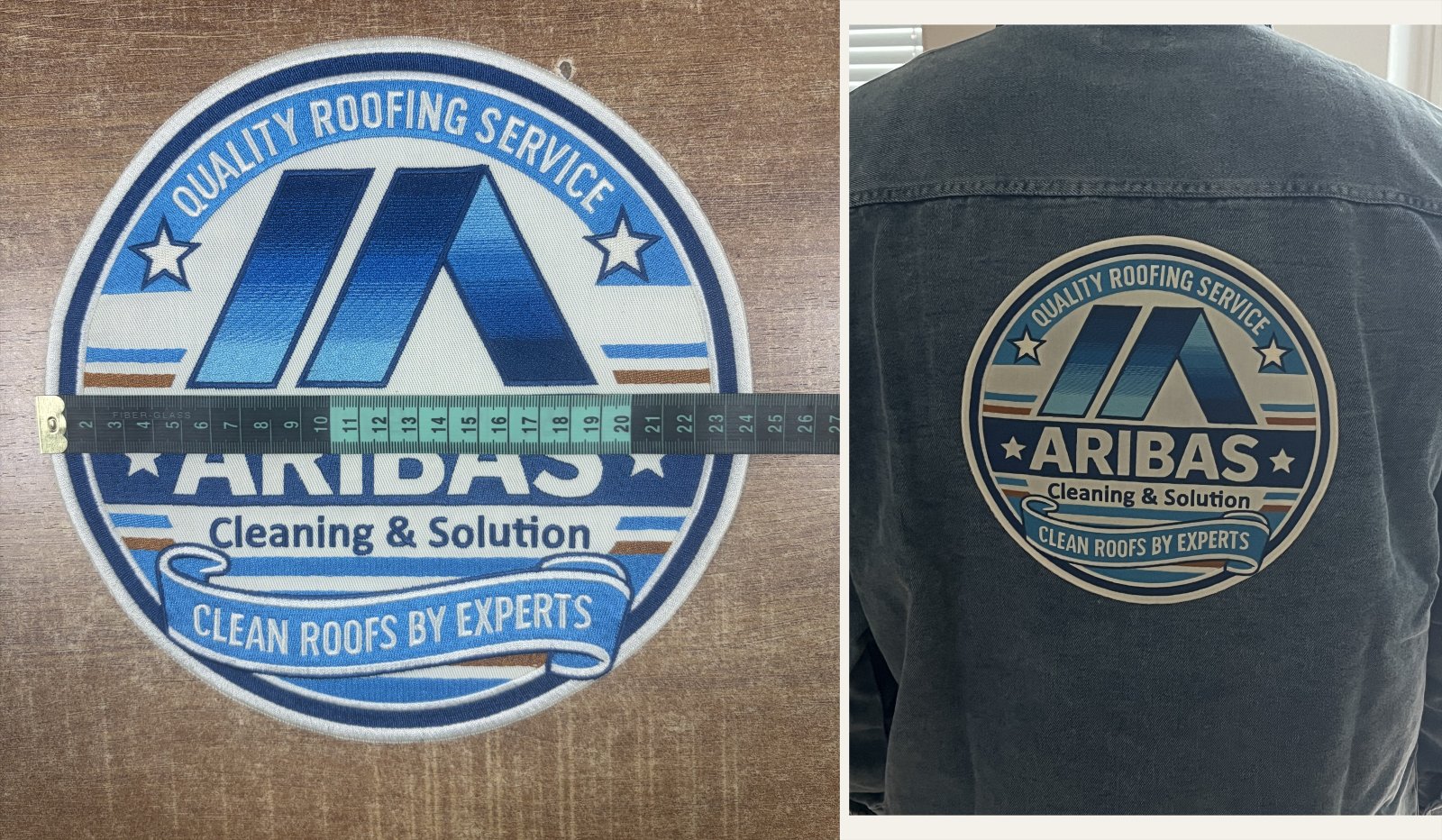
SIZE REFERENCE · DENIM JACKET PLACEMENT
On this page
BACK-PANEL APPLICATION REQUIREMENTS
Choose the Placement Before Sizing a Custom Back Patch
The widest part of the garment is not necessarily a usable patch area. Shoulder yokes, center seams, side panels, and armholes shape the available space. Check a full-size outline on a representative garment before deciding how much of the back the emblem should cover.
01
Jacket back panels
A yoke, center seam, lining, or side panel can interrupt the outline or complicate sewing access. A design that looks centered when a jacket lies flat may fold differently when it is worn.
Before quoting: Mark the whole border on a representative jacket and check it while reaching forward and sitting. Identify pockets and lining behind the proposed area. See jacket-specific patch placement for garment construction considerations.
02
Custom back patches for vest panels
Vests have less room near the armholes and can vary substantially in width between sizes. A broad emblem on the largest vest may leave insufficient clearance on the smallest.
Before quoting: Check the usable back area on the smallest intended vest. Include the full border and any gaps between separate pieces. Confirm fabric, lining access, and the approved attachment route with the garment maker or decorator.
03
Workwear and uniform back identity
A back emblem can carry a company name and recognizable logo, but surrounding garment markings and functional details still need to remain usable. Large-format artwork should support identification without crowding the panel.
Before quoting: Supply approved wording and the actual workwear reference. Do not cover required visibility features or garment markings. Review the intended placement and care requirements with the uniform supplier.
04
One-piece emblems and multi-piece layouts
A single integrated patch and a center emblem with separate surrounding pieces are different orders. Counting only completed layouts can leave the number of physical patches unclear.
Before quoting: Identify each component, its outline, spacing, and quantity as well as the overall arrangement. If the design is a club set, compare the motorcycle patch layout guidance. Confirm the component totals within the MOQ.
RECOMMENDED PATCH TYPES
Choose a Face for Your Custom Back Patches
Compare embroidery for bold stitched emblems, woven fabric for detailed lettering, and printing for illustrated artwork. Large format makes surface coverage and the finished feel more noticeable, so approve construction together with the actual garment rather than choosing only from a flat artwork preview.
01
BOLD BACK EMBLEMS & STITCHED TEXTURE
Embroidered patches
Embroidered custom back patches suit strong lettering and recognizable center emblems where thread texture is part of the design. Review broad filled areas, border width, and small details at the finished dimensions. A larger patch allows more layout space, but heavy stitch coverage can change how it feels on a soft garment.
Watch for: Dense stitching across a broad area may make the back feel stiffer. The edge can also sit unevenly when it crosses a seam or a naturally curved panel.
Choose another type when: fine solid-color lettering needs a flatter face or the design depends on gradients. Compare woven or printed construction before expanding the patch beyond the available garment space.
02
DETAILED EMBLEMS & FINE LETTERING
Woven patches
Woven patches use a flatter textile face for detailed logos, narrow mottos, and complex linework. For custom large patches, review the smallest lettering as well as the overall visual balance. Border, base, and backing still contribute to the finished profile and should be evaluated together.
Watch for: Fine weaving does not guarantee every small detail will be readable. A large woven face can still feel structured once its backing and edge finish are added.
Choose another type when: raised stitched texture is essential to the approved brand or club appearance. Do not substitute woven for embroidery solely to retain tiny details without approving the different finish.
03
ILLUSTRATIONS & CONTINUOUS-COLOR ARTWORK
Printed patches
Printed custom back patches suit shaded illustrations, color transitions, and detailed artwork on a textile face. Enlarged output needs a source file suitable for the final print dimensions. Keep important wording and illustration features inside the usable design area after the border is applied.
Watch for: Enlarging a small screenshot does not restore missing image detail. Color and sharpness should be reviewed on the selected material, not judged only from a backlit monitor.
Choose another type when: visible stitches or raised thread texture define the intended appearance. Printing can preserve an illustrated design but does not reproduce the physical surface of embroidery.
Iron-on vs Hook-and-Loop vs Sew-on Uniform Patches
| Comparison | Iron-on Uniform Patches | Hook-and-Loop Uniform Patches | Sew-on Uniform Patches |
|---|---|---|---|
| Attachment method | Applied to the garment with heat-activated adhesive using a heat press or iron. | The patch has a hook backing, while the garment needs a sewn-on loop surface for attachment. | Stitches secure the patch directly to the garment around its edge. |
| Installation considerations | Check that the garment tolerates heat and pressure. Application time and cost depend on the fabric, equipment, and batch setup. | Higher cost because the loop side must be sewn onto the uniform first, adding labor and processing time. | Allow for sewing access, thread choice, and stitching time at each placement. |
| Flexibility | Intended to stay attached; not designed for routine removal or swapping. Permanent backing. Once applied, it is difficult to remove. | Removable, replaceable, and reusable. | Intended as a fixed attachment; removing it requires unpicking the stitches. |
| Reuse | Low reusability. The patch usually stays with the garment until the uniform is no longer used | High reusability. The patch can be removed and used on other uniforms. | May be transferred after careful unpicking, but inspect the patch and garment for stitch marks or damage. |
| Washing considerations | Confirm compatibility with the uniform’s care routine. Do not assume the bond is suitable for industrial washing or high-temperature drying. | Remove the patch before washing when instructed, and follow the care requirements for the garment and loop panel. | Follow the care requirements of the garment, patch, and thread. Inspect stitching and edges during repeated use. |
| Uniform fit | Suitable for shirts, polo shirts, school uniforms, hotel uniforms, and light workwear. | Suitable for jackets, tactical gear, security uniforms, vests, outdoor workwear, and heavy-duty workwear. | Consider for permanent school, company, and workwear emblems where sewing is permitted. Check coated, waterproof, or protective garments before stitching. |
| Explore backing options | Iron-On Patches → | Hook & Loop Patches → | Sew-On Patches → |
OUTLINE · COVERAGE · ATTACHMENT · ACCEPTANCE
Approve Custom Large Patches on the Actual Garment
A correct logo and nominal width are not enough for a large back design. Confirm the complete outer dimensions, construction, edge, attachment route, and garment fit together. Resolve any limits before production rather than treating mounting as a separate final decision.
FINISHED OUTLINE & GARMENT SIZE
Measure the Whole Back Patch, Including Its Border
Buyer problem: The center artwork fits, but the finished edge extends onto a yoke, seam, armhole area, or side panel.
Evaluate: Use a full-size paper outline that includes the border. Place it on the smallest intended garment and check the relationship to the yoke, center line, and side seams while the garment is worn.
Recommended direction: Approve both finished width and height, the measurement points, and placement. A photo with a ruler is useful context, but perspective and tape alignment do not replace a written dimension specification.
SURFACE COVERAGE & MOVEMENT
Review the Finished Feel Across a Broad Area
Buyer problem: An enlarged emblem may feel stiffer than the smaller sample used for reference. Broad filled areas can respond differently where the garment bends.
Evaluate: Compare the planned construction, coverage, backing, and edge on the actual garment. Check the outline during normal reaching and sitting rather than judging only a flat photograph.
Recommended direction: Approve a representative finished construction when feel or drape is critical. Consider a flatter textile face or revised coverage when appropriate; do not assume that simply scaling up a small patch preserves its flexibility.
LINING ACCESS & BACKING
Resolve Attachment Before the Bulk Order
Buyer problem: Sewing can catch a lining or internal pocket, and heat application may be incompatible with leather finishes, coatings, or garment construction. A large removable patch also needs a matching receiving area.
Evaluate: Confirm access behind the intended location and an approved sewing or heat-application method with the garment maker or decorator. For hook-backed designs, check complete backing coverage and the receiving loop panel.
Recommended direction: Specify the attachment and border together. Standard shapes with a merrowed edge are our preferred hook-backed configuration; irregular outlines need review for alignment. Sew-on and iron-on shapes are not restricted in the same way, but neither method is automatically suitable for every garment.
ARTWORK SCALE & VERSION CONTROL
Approve Large-Format Detail Without Guessing
Buyer problem: A small raster file can become visibly soft when enlarged, while versions with different garment sizes may be mixed if their specifications are not clearly identified.
Evaluate: Review the source artwork at the intended output dimensions. Check exact wording, fine lines, border clearance, and any design simplification. Record the dimensions, backing, garment reference, and quantity for each version.
Recommended direction: Use clear artwork and an approved version list. State the required arrival date and confirm timing in the quotation. Retain the full layout when separate components are supplied, with quantities expressed as physical patches as well as complete sets.
Keep the complete outline, authorized artwork, garment reference, backing, and quantity breakdown with the approved specification. For fabric and lining considerations, see patch planning for jackets. For club rockers and chapter layouts, see motorcycle patch set planning.

Factory-direct B2B support
Why choose PatchCraftPro?
Factory-direct pricing, without layered outsourcing
We are a patch factory, not a middleman adding markups after passing the order through multiple subcontractors. Product options are quoted at factory-direct pricing.
See the design first, then pay after approval
We do not collect payment before you confirm the design effect. If the design or sample result is not satisfactory, you can request unlimited free revisions before production begins.
Every patch checked, plus 5–10% extra quantity
Every patch is inspected before shipment with a 100% quality guarantee. We also include approximately 5–10% extra patches at no charge—for example, a 200-piece order ships with about 210 pieces—to protect both usable quality and delivered quantity.
Built for B2B batch production and technical support
As a direct patch manufacturer, our factory operates more than ten imported Barudan and Tajima machines configured for B2B batch production, supported by a professional technical team. Global air-express shipping is free, carries no import duties, and normally arrives in 5–15 days instead of the 20+ days commonly required by sea freight.
Why Are Our Custom Back Patches Better?
- Whole-Panel Planning: Evaluate the finished border and outer dimensions against the usable back panel rather than sizing from the logo alone.
- Construction Matched to Coverage: Compare thread texture, fine woven details, and printed artwork with the intended coverage and garment feel.
- Clear Bulk Specifications: Identify each approved size, garment application, backing, and quantity. MOQ 200 pcs; confirm any version split in the quotation.
Our Services
Practical support for your uniform patch project, from artwork review to packing and delivery arrangements.
Artwork & Proof Support
Send your logo and requirements for review. Confirm the digital proof and order details before production; discuss any physical sample needs in advance.
Patch Selection Advice
We help you compare patch types and attachment options around your design, uniform fabric, placement, and intended use.
Order Quality Checks
Your approved artwork and order specification provide the reference for production and checks before shipment.
Packaging & Delivery Support
Tell us your brand-label, individual or grouped packing, white-label, or neutral-shipping needs before quotation. Packaging details and destination requirements are confirmed for your order.
10-Day Leadtime
Bulk production completed in as fast as 10 days, rush order available.
Featured brand work
Made to higher standards for brands
Using the same factory network and production standards as Evisu, adidas and Champion.
BRAND PRODUCTION MEDIA
Evisu · Streetwear · Brand launches
Made for streetwear drops and repeat collections
BRAND PRODUCTION MEDIA
adidas · Clubs · Sports programs
Built for clubs—and worn far beyond the field
BRAND PRODUCTION MEDIA
Champion · Apparel · Retail programs
Consistent embroidered identity across repeat releases
Inside a Real Patch Factory
Real equipment. Real production accountability.
Our workshop brings digital design, sampling, embroidery production, finishing and inspection together in Humen, Dongguan.


Selected brand work
Explore Our Precision Embroidery & Patch Work for Premium Fashion Brands
A closer look at detailed stitching, layered textures and expressive garment embroidery.


Quick product decision
Compare Materials for Custom Back Patches
Use the artwork, required surface, and finished garment fit to compare constructions. A large-format textile emblem and a molded accessory patch have different profiles; do not treat every material as an interchangeable way to enlarge the same design.
| Decision point | Woven | Embroidered | Printed | PVC |
|---|---|---|---|---|
| Surface | Flat woven textile | Raised visible stitching | Smooth printed face | Molded flexible surface |
| Back application fit | Detailed back emblems and narrow company or club wording | Bold company names and stitched back emblems | Large illustrated back designs and continuous-color artwork | Molded identifiers for compatible removable accessory panels |
| Key tradeoff | Less raised texture than embroidery | Very fine lines and small text need review at the finished size | No woven or stitched thread texture | Not a textile surface; assess thickness and feel on the garment |
| Comparison guide | Embroidered vs Woven Patches | Embroidered vs PVC Patches | Printed vs Woven Patches | Woven vs PVC Patches |
HOW TO ORDER
How to Work with Us?
Send the design, confirm the details, and receive the patches for your uniform program.
1
Send your design and requirements
Share your logo or emblem, garment use, placement, size, quantity, backing preference, and destination. We review the details to prepare a quotation.
2
Confirm your proof and order
Review the digital proof and quoted specification. Any physical sample requirement is agreed before bulk production; production follows your approval.
3
Receive your custom patches
Your approved order moves through production and checks, then ships to the confirmed destination. Confirm your required arrival date when sending the inquiry.
Choose How to Contact Us
Use the custom form
Choose your patch options and upload artwork in our builder. Include the uniform application and placement so the quotation addresses the actual garment.
Chat on WhatsApp
Discuss the uniform project with our team. Send the same specification and artwork you would provide through the form.
Email our team
Send your approved artwork and project requirements to sales@patchcraftpro.com. For ongoing supply, include the expected ordering schedule.
For an accurate quote and clear proof: whichever contact method you choose, provide the same artwork and project details. MOQ 200 pcs.
SEND THESE DETAILS
Uniform Patches Custom-Made for Your Program
- Application: school, company, workwear, sports, military, field, or other uniform program
- Placement: chest, above pocket, sleeve, shoulder, outerwear panel, or gear location
- Finished size: measured usable area or requested width and height for each placement
- Quantity: total order (MOQ 200 pcs) and the breakdown by garment style, placement, approved size, or colorway
- Artwork: approved organization logo or emblem file, exact wording, and required color references
- Attachment: sew-on, hook-and-loop, iron-on, or a request for guidance
- Destination: shipping country or destination needed for the quote
Minimum order quantity: 200 pcs. Include the full quantity breakdown when the program has several garment styles, placements, sizes, or colorways.
COMPARE THE PROCUREMENT ROUTE
China vs USA Custom Patch Maker
Use the same artwork, quantity, finished size, and attachment when comparing suppliers. This is a purchasing checklist, not a claim that every supplier in one country works the same way.
| Buying factor | China-based factory supply | US-based supplier |
|---|---|---|
| Cost | Highly competitive due to integrated supply chains and economies of scale. Ideal for bulk orders. | Higher costs driven by labor and material expenses. More suitable for small, premium orders. |
| Customization | Extremely flexible. Wide range of options including backing types, patch types, and custom shapes. | More limited. Typically focused on a few standardized production options. |
| MOQ | Flexible. Can handle everything from small batches to large-scale production (up to millions of units). | There is usually no minimum order requirement, but pricing is generally based on size rather than the actual technical details and production costs of the patch. Patches with simple designs and small-batch orders are priced much higher. Pricing for bulk orders is also difficult to control effectively. |
| Logistics | International express shipping typically takes 5–15 days, depending on the shipping method. It may be affected by customs clearance. | Local manufacturers can dispatch small-batch orders within 1–3 days. For bulk orders, most suppliers source production from other countries; dispatch may take 15 days or longer, and they cannot resolve quality issues that arise. |
| Communication | Time zone differences may exist, but most suppliers offer responsive 24-hour sales support. | No time difference. Easier communication with full language and cultural alignment. |
LARGE BACK PATCH BULK ORDER FAQ
Custom Back Patches: Buyer Questions
Confirm the usable panel, artwork detail, attachment access, and batch specifications before ordering for jackets, vests, or uniform programs.
How should I choose the size of custom back patches?
Measure the usable panel on the actual garment and include the entire border in a full-size outline. Check the smallest intended garment and its yoke, armholes, side panels, and seams. Approve finished width and height together; a single width taken from a photograph does not establish the complete fit.
Can custom back patches for vest panels be sewn onto leather?
A sew-on design can be specified when the garment construction allows it, but the garment maker or decorator must confirm access and the sewing route. Check the lining and pockets behind the patch. Do not assume an iron-on backing is compatible with a leather finish or coated surface.
Which material works for custom large patches?
Embroidery suits bold stitched emblems, woven fabric suits fine solid-color lettering and linework, and printing suits shaded or multicolor illustrations. Compare the required appearance, broad surface coverage, border, and backing on the actual garment. Large format does not remove the limitations of the chosen construction.
Will enlarging a small patch change how it feels?
It can. Broader filled areas, backing, and edging can make stiffness more noticeable across a jacket or vest panel. Review the finished construction and movement on the garment rather than assuming a small sample represents the larger version. Confirm a representative sample when feel and drape are important.
Can a custom back patch use hook-and-loop backing?
First confirm the garment has a suitable receiving loop panel or permits one to be added. Check the complete outer outline and backing coverage. Standard shapes with a merrowed edge are our preferred hook-backed configuration; irregular shapes require review. State whether hook only or a separate matching loop piece is needed.
What is the minimum order for custom back patches?
MOQ is 200 pcs. List the quantity of each size, design, and backing version, and confirm the allowed split in the quotation. For a layout containing several separate patches, distinguish component counts from complete-set counts. Finished jackets and vests are not included.
Can you reproduce a detailed design at a large back-patch size?
Submit the clearest available source artwork and specify the final dimensions. Printing may suit gradients, woven construction may suit fine solid-color details, and embroidery provides visible stitched texture. Enlarging a low-resolution screenshot cannot restore missing detail. Approve any simplification and final wording before production.
READY TO PLAN YOUR BACK DESIGN?
Request a Bulk Quote for Custom Back Patches
Send authorized artwork, garment type and fabric, a back-panel photo, finished width and height, material preference, border, backing, quantity per version, and destination. Include the smallest garment size and any separate layout components. MOQ 200 pcs; final size and construction require review.